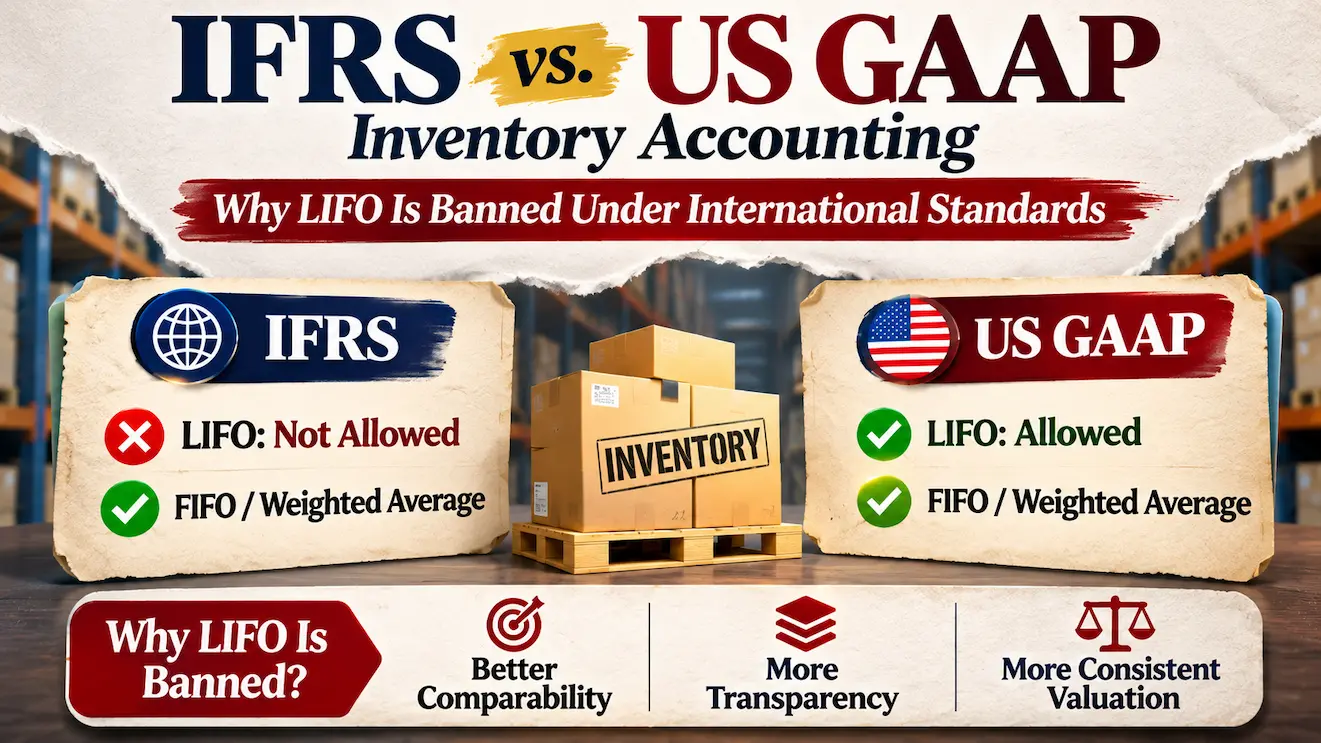
One of the most significant practical differences between IFRS and US GAAP is how companies value their inventory. Under IFRS vs US GAAP, the choice of inventory cost method directly affects a company's reported profit, tax liability, and balance sheet - especially during periods of rising prices.
What Is Inventory Valuation in Accounting?
Inventory valuation determines the cost assigned to goods sold (cost of goods sold, or COGS) and the value of unsold goods remaining on the balance sheet. The method chosen affects net income, taxes, and working capital calculations.
The three main cost flow assumptions used globally are:
FIFO (First-In, First-Out): Oldest costs are assigned to COGS first.
LIFO (Last-In, First-Out): Most recent costs are assigned to COGS first.
Weighted Average Cost: An average cost is applied to all units.
The Core Difference: LIFO Is Banned Under IFRS
Under US GAAP (governed by FASB), companies may choose FIFO, LIFO, or weighted average cost. The LIFO method is widely used by US companies - particularly in industries like oil and gas, retail, and auto dealerships - because it typically reduces taxable income when prices are rising.
Under IFRS (governed by IASB), LIFO is explicitly prohibited. IAS 2 (Inventories) only permits FIFO or weighted average cost. This means a multinational company reporting under both standards must use different inventory methods for different jurisdictions - adding complexity to financial reporting.
Method | US GAAP Allowed? | IFRS Allowed? | Effect in Rising Price Environment |
|---|---|---|---|
FIFO | ? Yes | ? Yes | Higher net income, higher inventory on balance sheet |
LIFO | ? Yes | ? No (IAS 2) | Lower net income, lower taxes, lower inventory value |
Weighted Average | ? Yes | ? Yes | Moderate - between FIFO and LIFO results |
Why Does US GAAP Allow LIFO?
LIFO has been permitted under US GAAP for decades, primarily because the IRS allows it for tax purposes under the LIFO conformity rule - if a company uses LIFO for tax reporting, it must also use LIFO for financial reporting. This creates a strong incentive for US companies to adopt LIFO when commodity prices are volatile or rising.
However, critics argue that LIFO distorts inventory values on the balance sheet (carrying old, low-cost inventory that may be decades old), and that it makes cross-company comparison difficult - especially when comparing US companies to international peers reporting under IFRS.
The LIFO Reserve: Bridging the Gap
US companies using LIFO are required to disclose their LIFO reserve - the difference between the LIFO inventory value and what that inventory would be worth under FIFO. Analysts and investors often add the LIFO reserve back to inventory when comparing LIFO companies to FIFO or IFRS companies.
Formula: FIFO Inventory = LIFO Inventory + LIFO Reserve
For example, if a company reports million in LIFO inventory with a LIFO reserve of million, the comparable FIFO inventory would be million - a significant difference that affects return on assets, current ratio, and other metrics relevant to the working capital ratio.
Inventory Valuation Under IAS 2 (IFRS)
IAS 2 requires inventory to be measured at the lower of cost and net realizable value (NRV). Net realizable value is the estimated selling price in the ordinary course of business minus the estimated costs of completion and estimated costs necessary to make the sale.
Key IAS 2 requirements:
Cost includes purchase price, import duties, transport, and directly attributable costs
FIFO or weighted average must be applied consistently to all inventories of a similar nature
Write-downs to NRV are required when market value falls below cost
Write-downs may be reversed if circumstances change - unlike US GAAP which prohibits reversal of inventory write-downs
Inventory Valuation Under ASC 330 (US GAAP)
US GAAP inventory rules are governed primarily by ASC 330 (Inventory). Unlike IFRS, US GAAP measures inventory at the lower of cost or market (LCM), where "market" means current replacement cost (subject to ceiling and floor constraints).
As of ASU 2015-11, most entities (except those using LIFO or retail inventory method) must apply the simpler lower of cost or net realizable value standard - aligning more closely with IFRS on this point.
Practical Impact: Why This Matters for Analysts
When comparing financial statements of US companies (especially those using LIFO) with international peers reporting under IFRS, analysts must adjust for:
Profitability: LIFO companies show lower gross margins in inflationary periods - but this is a tax-driven accounting choice, not an operational difference
Inventory turnover: LIFO inventory balances are understated relative to current costs; ratios using inventory must be adjusted
Tax shield value: The LIFO tax benefit has real economic value - when LIFO is eliminated (as proposed in various US tax reform discussions), it represents a real cash cost to companies
Consistency: Sector analysis must adjust for inventory method differences to get comparable metrics - particularly in oil and gas, automotive, and retail sectors
IFRS Convergence Efforts on Inventory
The FASB and IASB have long debated whether to converge inventory accounting standards. The IASB has consistently maintained the LIFO prohibition. The FASB has considered eliminating LIFO but has not done so, partly due to the significant tax implications for US companies and the political pressure from affected industries.
As of 2026, there is no active convergence project specifically targeting the LIFO prohibition - meaning this remains one of the most persistent practical differences between IFRS and US GAAP.
Key Takeaways
LIFO is permitted under US GAAP but prohibited under IFRS (IAS 2)
FIFO and weighted average cost are allowed under both standards
LIFO reduces taxes in rising-price environments but distorts balance sheet inventory values
The LIFO reserve disclosure allows analysts to compare LIFO and FIFO companies
IFRS requires inventory write-downs to NRV; US GAAP uses lower of cost or market (LCM)
IFRS allows reversal of inventory write-downs; US GAAP does not
Is LIFO allowed under IFRS?
No. LIFO (Last-In, First-Out) is explicitly prohibited under IFRS. IAS 2 only permits FIFO (First-In, First-Out) and weighted average cost methods for inventory valuation. This is one of the key differences between IFRS and US GAAP.
Why does US GAAP allow LIFO but IFRS does not?
US GAAP allows LIFO primarily due to the IRS LIFO conformity rule, which creates a tax incentive for companies to use LIFO. IFRS prohibits LIFO because it can produce inventory values on the balance sheet that are significantly different from current costs, reducing comparability across companies.
What is the LIFO reserve and why does it matter?
The LIFO reserve is the difference between what a company's inventory would be worth under FIFO and its reported LIFO value. Analysts add the LIFO reserve back to inventory when comparing LIFO companies with FIFO or IFRS companies, ensuring apples-to-apples comparisons of balance sheet values and profitability metrics.
How does inventory write-down differ between IFRS and US GAAP?
Under IFRS (IAS 2), inventory write-downs to net realizable value can be reversed in later periods if circumstances improve. Under US GAAP (ASC 330), inventory write-downs are permanent and cannot be reversed. This can lead to differences in reported income when market conditions recover.
What is the cost model under IFRS vs US GAAP?
Under IFRS, inventory is measured at the lower of cost and net realizable value (NRV), using FIFO or weighted average. Under US GAAP, inventory is measured at the lower of cost or market (LCM) or lower of cost or net realizable value, with LIFO, FIFO, or weighted average all permitted.
?? Related Tools: Use our compound interest calculator to model how your savings compound over time. Use our US inflation and purchasing power calculator to see how price increases erode your dollar's buying power.