Quick Answer: Stock Market Today 2026
The stock market has been on a rollercoaster through 2026, tracking almost every twist in the US Iran conflict. When fighting escalates, stocks fall and oil jumps; when ceasefire talks progress, stocks recover. As of July 17, 2026, the Dow, S&P 500, and Nasdaq were all lower after the US renewed strikes near the Strait of Hormuz and Iran retaliated against US allies including Kuwait, Jordan, and Qatar, with the Nasdaq leading declines as semiconductor stocks came under pressure. This pattern, geopolitical shock, market dip, partial recovery, repeated, has defined trading for most of the year, and it's directly connected to the oil price break down here, since rising crude is one of the biggest channels through which this conflict reaches your portfolio.
Key Takeaways: Stock Market Today 2026
The S&P 500, Dow, and Nasdaq have moved in near lockstep with headlines from the US Iran conflict throughout 2026, falling on escalation and recovering on de-escalation
On July 13, 2026, the S&P 500 dropped 0.79% and the Nasdaq fell 1.55% after President Trump announced a reinstated blockade on Iranian shipping through the Strait of Hormuz
On July 17, the Nasdaq led declines again, down 1.4%, as chip stocks tumbled and Iran struck US allies Kuwait, Jordan, and Qatar following renewed US strikes over the weekend
Energy stocks have been the most consistent winners, with the S&P 500 energy sector jumping as much as 1.4% on days when oil spiked hardest
Bank stocks have held up unusually well even during the conflict, with Goldman Sachs popping 9% and JPMorgan Chase and Bank of America both gaining on strong Q2 2026 earnings in mid-July
The Magnificent Seven, Nvidia, Microsoft, Apple, Alphabet, Amazon, Meta, and Tesla, were down roughly 12% to 13% for the year at one point in March 2026, significantly underperforming the broader S&P 500
Markets have shown they can recover quickly on ceasefire news, as seen in early April and again after June's memorandum of understanding, before this month's renewed escalation
The Pattern: Escalation Down, Ceasefire Hopes Up
If you've been watching the market this year, a clear pattern has emerged. Nearly every major move in the S&P 500, Dow, and Nasdaq since late February can be traced back to a specific headline out of the Middle East.
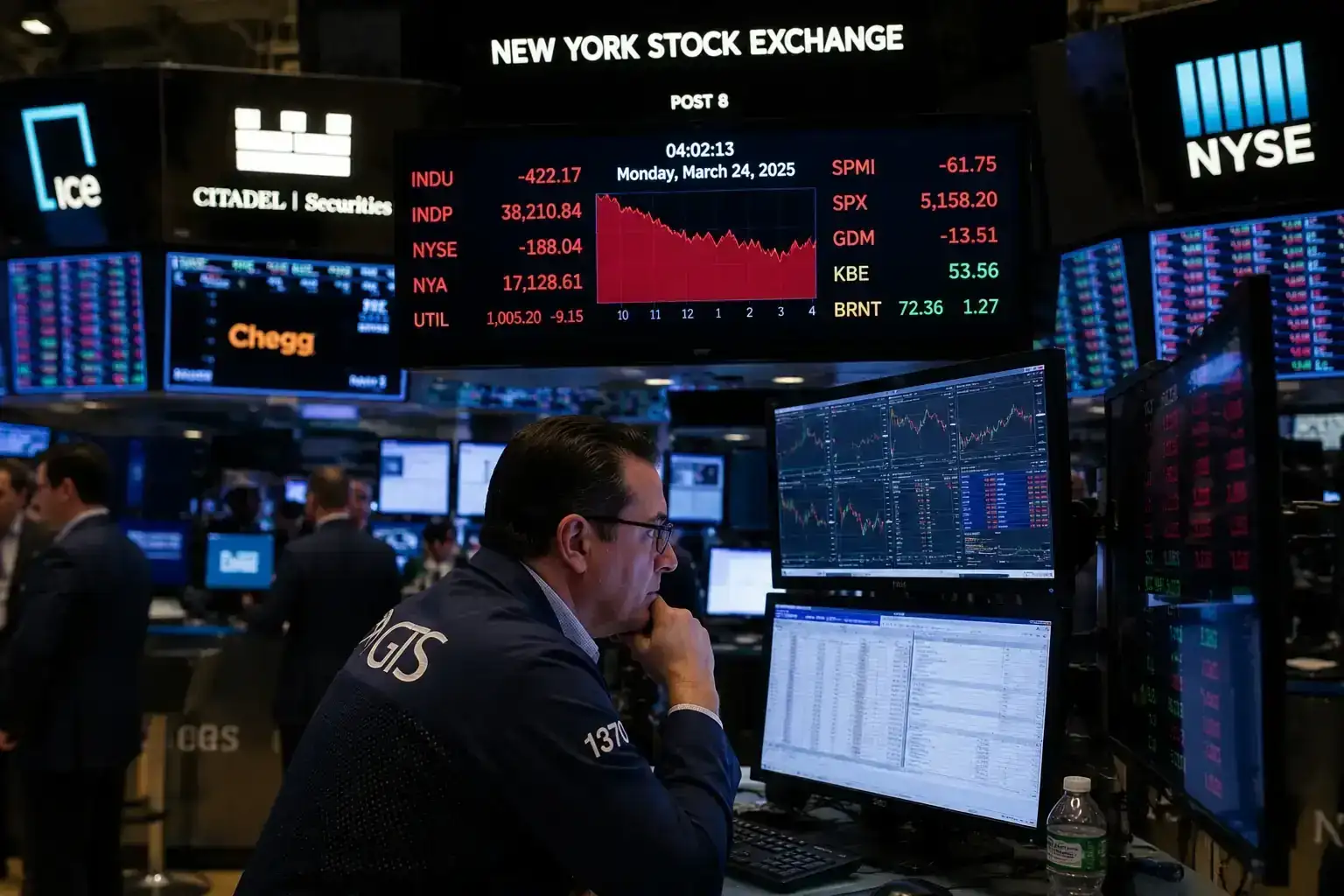
Early March 2026: After the conflict began on February 28, stocks swung wildly. On March 2, the S&P 500 recovered from a nearly 3% intraday drop to close up 0.14%, while energy stocks jumped as the sole positive sector, up 1.4%, as oil prices posted their largest single-day gain in years. By March 24, all four major US indices, the Dow, S&P 500, Nasdaq, and Russell 2000, were falling again as Iran began charging informal transit fees of up to $2 million per voyage on vessels passing through the Strait of Hormuz, and the Magnificent Seven stocks were down 12% to 13% for the year, badly underperforming the broader market.
Early April 2026: A cautious ceasefire narrative took hold, and markets responded. On April 6, the S&P 500 rose 0.44% to 6,611.83, the Nasdaq gained 0.54%, and the Dow added 0.36%, as investors balanced ceasefire hopes against still-volatile oil markets. Defense stocks like Kratos Defense and Security Solutions rallied on resilience in that sector, while financial services and consumer cyclical stocks led the gains.
June 2026: The US and Iran signed a memorandum of understanding after 60 days of negotiations, aimed at ending the war and reopening the Strait of Hormuz. Markets, along with oil prices, calmed considerably.
Mid July 2026: The truce didn't hold. On July 7, President Trump told the NATO summit in Turkey that the ceasefire was "over" amid renewed hostilities, and the Dow dropped 576.76 points, or 1.09%, to close at 52,348.39, while the S&P 500 slipped 0.28% to 7,482.71. Brent crude settled up 5.43% that day. On July 12, stocks fell again after Trump announced he was reinstating what he called a blockade on Iranian shipping, with the S&P 500 losing 0.79% to close at 7,515.34 and the Nasdaq falling 1.55% to 25,873.18. By July 13, Iran said it had closed the Strait of Hormuz entirely in response, and semiconductor stocks led fresh declines as the Nasdaq dropped 1.4% to 1.6% across the following sessions. On July 17, the pattern continued: the Dow fell 0.77%, the S&P 500 dropped 1.01%, and the Nasdaq declined 1.40%, with chipmaker SK Hynix among the biggest losers, after the US renewed strikes near the Strait over the weekend and Iran retaliated against Kuwait, Jordan, and Qatar.
Market Moves at a Glance
Date | S&P 500 | Nasdaq | Dow | What Triggered It |
|---|---|---|---|---|
Mar 2, 2026 | +0.14% | +0.36% | -0.15% | Markets rebound after early conflict shock; energy leads |
Mar 24, 2026 | Down | Down | Down | Iran begins charging transit fees in the Strait of Hormuz |
Apr 6, 2026 | +0.44% | +0.54% | +0.36% | Cautious ceasefire hopes lift sentiment |
Jul 7, 2026 | -0.28% | +0.20% | -1.09% | Trump declares the ceasefire "over" at NATO summit |
Jul 12, 2026 | -0.79% | -1.55% | -0.26% | Trump announces reinstated Iran shipping blockade |
Jul 13, 2026 | -0.8% | -1.6% | -0.3% | Iran says it has closed the Strait of Hormuz |
Jul 14, 2026 | +0.38% | +0.9% | +0.02% | Strong bank earnings (Goldman Sachs, JPMorgan, BofA) offset conflict worries |
Jul 17, 2026 | -1.01% | -1.40% | -0.77% | Renewed US strikes; Iran hits Kuwait, Jordan, and Qatar |
Figures compiled from CNBC, Yahoo Finance, TheStreet, and AOL Finance stock market coverage. Percentage moves are approximate closing changes for each session. Markets move throughout the trading day, so always check a live source for current levels.
Which Sectors Are Winning and Losing
Energy stocks have been the most reliable winners of this entire conflict. Every time oil spikes on fresh escalation, energy shares tend to jump alongside it, since higher crude prices directly improve profit margins for producers. This mirrors what we covered in our full breakdown of the 2026 oil price surge, where energy sector strength was one of the clearest patterns to emerge from the conflict.
Semiconductor and chip stocks have been consistent losers during escalation periods, with names like SK Hynix among the hardest hit as investors rotate away from higher-risk tech names during risk-off stretches. The broader "Magnificent Seven" group, Nvidia, Microsoft, Apple, Alphabet, Amazon, Meta, and Tesla, was down roughly 12% to 13% for the year at one point in March, a striking underperformance against the S&P 500 as a whole.
Bank stocks have been a genuine surprise. Even as the broader market wobbled in mid-July, Goldman Sachs jumped 9% on a Q2 earnings beat, while JPMorgan Chase and Bank of America both posted gains of roughly 2% on their own results. Strong corporate earnings have, at times, been powerful enough to offset geopolitical anxiety, at least for a session or two.
Defense stocks have occasionally rallied on resilience during the conflict, and companies tied to hydrogen and alternative energy contracts have also seen isolated gains unrelated to the war itself, a reminder that not every stock move this year traces back to the Middle East.
Did You Know?
On March 24, 2026, the "Magnificent Seven" mega-cap tech stocks, which usually lead the broader market, were underperforming the S&P 500 by roughly 12 to 13 percentage points for the year, even as the index itself held up comparatively well.
What Stock Market Today 2026 Means for Your Portfolio
The single clearest lesson from 2026's market action is how quickly sentiment can swing in both directions. Stocks have fallen hard on escalation headlines and recovered just as fast on ceasefire progress, sometimes within the same week. Trying to trade around each individual headline has been genuinely difficult even for professional traders, since the news flow itself has repeatedly reversed course.
For long-term investors, this kind of environment is exactly why diversification matters. Concentrated bets on a single sector or a handful of mega-cap tech names, the same names that made up much of the Magnificent Seven's underperformance in March, have carried more risk this year than a broadly diversified approach. If you're building or rebalancing a portfolio during this kind of volatility, our beginner's guide to the best ETFs to buy in 2026 walks through how to spread risk across sectors rather than concentrating it.
Dividend-focused strategies have also drawn renewed attention during this stretch, since they can offer more stability than growth-heavy portfolios when headlines are moving markets day to day. If that's a strategy you're considering, our SCHD versus VYM comparison is a useful next read.
Finally, with markets this jumpy, it's worth making sure any cash you're holding on the sidelines isn't sitting idle. Parking it in one of the best high-yield savings accounts of July 2026 at least lets it earn a meaningful return while you wait for more clarity on how the conflict, and the broader market, ultimately shake out.
Frequently Asked Questions About Stock Market Today 2026
Why is the stock market down today? Throughout 2026, most single-day drops in the S&P 500, Dow, and Nasdaq have traced back to escalation in the US Iran conflict, particularly news involving the Strait of Hormuz, US strikes on Iran, or Iranian retaliation against US allies in the region. Check the latest headlines out of the Middle East for the most likely explanation on any given day.
Which stocks benefit from the Iran conflict? Energy sector stocks have been the most consistent beneficiaries, since rising oil prices directly improve profit margins for producers and refiners. Defense stocks have occasionally rallied as well during periods of escalation.
Which stocks have been hurt the most? Semiconductor and chip stocks have been among the hardest hit during risk-off periods tied to the conflict, and the broader "Magnificent Seven" mega-cap tech group significantly underperformed the S&P 500 at points in 2026.
Will the stock market recover if the Iran conflict ends? Markets have shown they can recover quickly on genuine ceasefire progress, as seen in early April 2026 and again after June's memorandum of understanding. However, this year has also shown that ceasefires can break down, so any recovery would likely remain sensitive to further developments.
How should I invest during this kind of volatility? Most financial advisors recommend maintaining a diversified portfolio across sectors rather than concentrating risk in any single trade tied to daily headlines, since 2026's market action has shown how quickly sentiment can reverse in both directions.
Key Takeaways Recap: Stock Market Today 2026
The stock market's 2026 story has been dominated by the US Iran conflict, with the S&P 500, Dow, and Nasdaq swinging on nearly every major escalation or de-escalation headline. Energy stocks have been the clearest winners, semiconductor and mega-cap tech names among the clearest losers, and bank stocks have shown surprising resilience on strong earnings even during rocky stretches. For investors, the year has reinforced a simple lesson: diversification and a long-term view tend to hold up better than trying to trade around a conflict whose next turn is genuinely difficult to predict.
This article is for informational and educational purposes only and does not constitute financial or investment advice. Stock prices are highly volatile and can change significantly within a single trading day. Speak with a licensed financial advisor before making investment decisions.
Sources:
Detroit News (Reuters) — S&P 500, Nasdaq decline as Iran tensions jolt sentiment
Trading Economics — US Futures Steady as US-Iran Conflict Monitored
📊 Related Tools: Use our US Inflation & Purchasing Power Calculator to track how geopolitical events, energy spikes, and tariff changes impact real purchasing power. Use our Mortgage Payment & Interest Rate Calculator to see how Federal Reserve rate adjustments and Treasury yields change monthly borrowing costs.
Frequently Asked Questions: Stock market news 2026
What is stock market news 2026 and why does it matter?
Stock market news 2026 provides crucial financial direction for investors and households. Understanding stock market news 2026 helps you make informed allocation choices, reduce unnecessary fees, and optimize your overall returns.
How can you apply stock market news 2026 in your financial strategy?
To implement stock market news 2026 successfully, start by assessing your current risk profile and timeline. Consistently monitoring stock market news 2026 ensures your portfolio stays aligned with long-term goals.
What are common pitfalls to avoid with stock market news 2026?
The most common mistake when evaluating stock market news 2026 is reacting to short-term market noise. Focus on verifiable data, compound growth, and proven principles when making decisions based on stock market news 2026.