Quick Answer: Fed Holds Rates Dow
The Federal Reserve voted 9 to 3 on July 29, 2026, to hold its benchmark interest rate steady in a range of 3.50% to 3.75%, with three regional Fed presidents, Beth Hammack of Cleveland, Neel Kashkari of Minneapolis, and Lorie Logan of Dallas, dissenting in favor of a rate hike. Despite the decision matching what markets expected, the Dow Jones Industrial Average fell more than 800 points that day, and the Nasdaq Composite was down roughly 9% from its June record high, as investors focused on Fed Chair Kevin Warsh's hawkish tone rather than the decision itself. The selloff didn't last. On July 30, Microsoft's blowout cloud earnings added $450 billion to its market cap and lifted the Dow. By July 31, the market had split sharply by company: Apple fell 9.5% on weak China and Services results, Coinbase sank nearly 14% on a wider than expected loss, while Amazon jumped more than 15% on its own earnings, and the 10-year Treasury yield climbed to its highest level since January 2025.
Key Takeaways: Fed Holds Rates Dow
The Fed held its benchmark rate steady at 3.50% to 3.75% on July 29, 2026, in a 9-3 vote, with three officials dissenting in favor of a hike
The Dow fell more than 800 points, and at one point over 1,100 points, on Fed decision day, even though the hold itself was widely expected
The Nasdaq Composite was down approximately 9% from its June 2026 record high as of July 29
Microsoft shares climbed after topping Wall Street estimates for quarterly cloud revenue growth on July 30, adding roughly $450 billion to its market capitalization in a single day
Meta Platforms raised its 2026 capital expenditure forecast to a range of $130 billion to $145 billion, up from a prior $125 billion to $145 billion range
On July 31, Apple shares fell 9.5% after weaker than expected China and Services results and soft fiscal fourth quarter revenue guidance
Coinbase Global shares sank nearly 14% on July 31 after reporting a wider than expected second quarter net loss and missing revenue estimates
Amazon shares surged more than 15% on July 31 following its own earnings report
The 10-year Treasury yield rose to its highest level since January 2025, a key reason mortgage rates and other long term borrowing costs have stayed elevated
Second quarter 2026 GDP grew just 1.5%, below the 2% economists had forecast and down from 2.1% in the first quarter
June 2026 PCE inflation, the Fed's preferred inflation gauge, rose 3.7% year over year, still well above the Fed's 2% target, while core PCE rose 3.3%
Why the Fed's "Expected" Decision Still Tanked the Market
Going into July 29, most economists and market pricing tools, including the CME FedWatch Tool, had already priced in roughly a 70% probability that the Fed would hold rates steady rather than hike. When the Federal Open Market Committee did exactly that, voting 9 to 3 to keep the federal funds rate in its 3.50% to 3.75% range, the market's reaction still turned sharply negative, which is worth understanding since it runs counter to how markets usually behave when a widely expected outcome actually happens.
Two things drove the selloff. First, the dissent itself was unusually pointed. Three regional Fed presidents, Beth Hammack, Neel Kashkari, and Lorie Logan, all voted for a quarter point hike instead, a sign of real internal disagreement about whether current policy is tight enough given inflation that's remained above the Fed's 2% target for more than five years. Fed Chair Kevin Warsh even welcomed the split publicly, telling reporters, "I asked for a good family fight, and I got one. That's the purpose. That's the design feature." As we covered in our preview of this Fed decision, a growing hawkish tilt among Fed officials had already been building for months, and this dissent confirmed it was more than just talk.
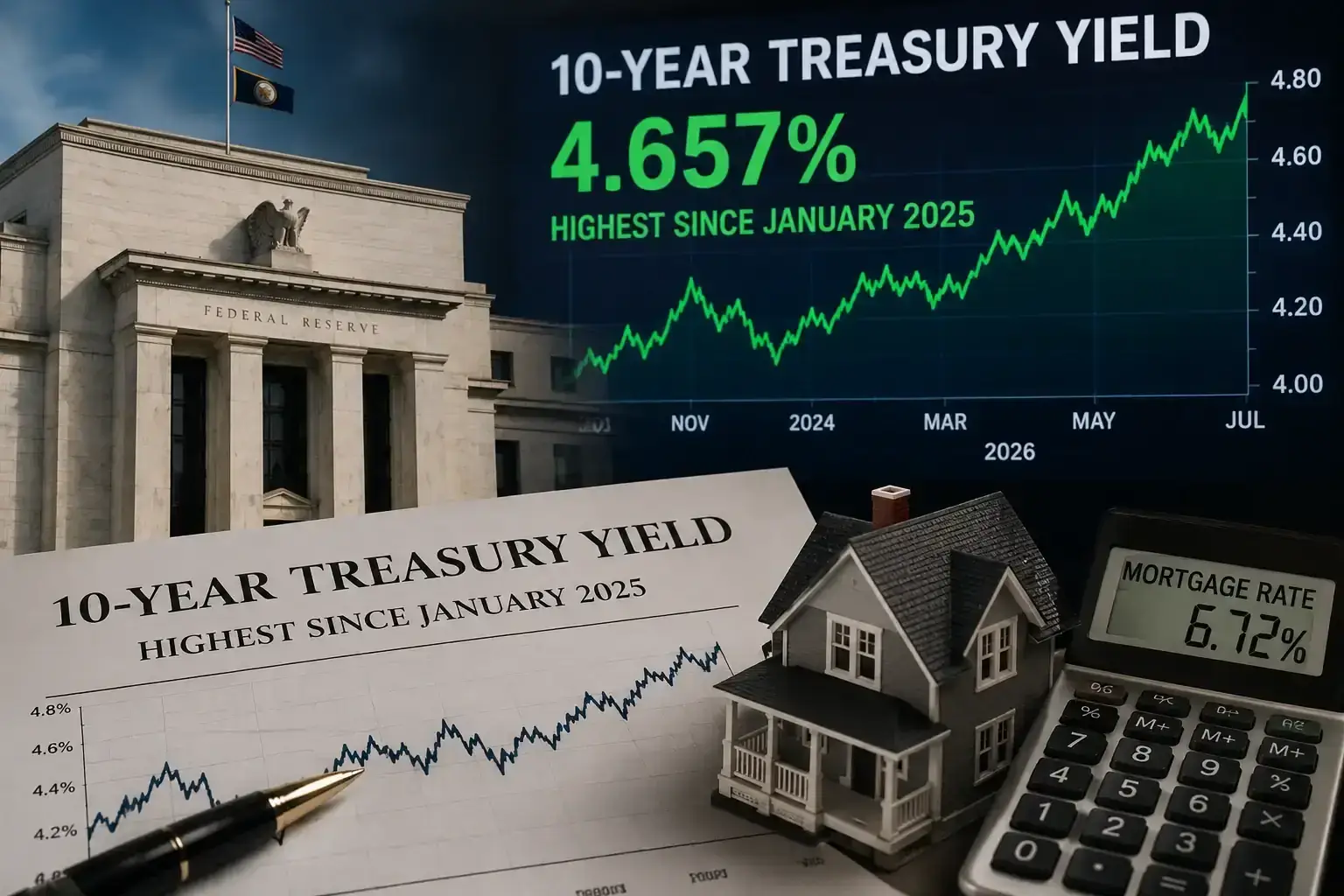
Second, Warsh's press conference reinforced that tone. Even though the committee held rates, Warsh reiterated the Fed's commitment to reining in inflation and noted that economic output remains strong and the labor market solid, language markets read as leaving the door open to a hike later in 2026 rather than signaling confidence that no further tightening would be needed. The Dow, weighed down further by a 6.8% drop in Caterpillar shares, fell as much as 1,100 points intraday before settling down over 800 points by the close. The 10-year Treasury yield rose 5 basis points to 4.657% that same day, while the 30-year Treasury bond yield climbed more than 9 basis points to 5.193%.
The Whiplash Week: Market Moves at a Glance
Date | What Happened | Market Reaction |
|---|---|---|
Jul 29, 2026 | Fed holds rates at 3.50%–3.75% in a 9-3 vote; 3 officials dissent for a hike | Dow falls 800+ points (over 1,100 intraday); Nasdaq down ~9% from June record |
Jul 29, 2026 (after close) | Microsoft and Meta report earnings | Meta raises 2026 capex to $130B–$145B; Microsoft beats on cloud revenue |
Jul 30, 2026 | Markets digest Microsoft's cloud beat | Dow rises as Microsoft's market cap gains ~$450 billion in a single day |
Jul 31, 2026 | Apple and Amazon report; Coinbase reports a wider loss | Apple falls 9.5%; Amazon jumps 15%+; Coinbase sinks ~14%; 10-year Treasury yield hits highest since January 2025 |
Figures compiled from CNBC, CNN Business, Yahoo Finance, TheStreet, and The Globe and Mail market coverage dated July 29 to 31, 2026. Intraday levels can shift throughout each trading session; always check a live source for current prices.
Big Tech Earnings Split the Market Right Down the Middle
If the Fed decision set the tone for the week, Big Tech's earnings reports scrambled it entirely, and not in a uniform direction. This is the same pattern we flagged in our big tech earnings season breakdown and again in our deep dive into Tesla's cash flow concerns: markets are rewarding AI spending when it's tied to clear, verifiable revenue, and punishing weakness anywhere else in a company's business, almost regardless of the broader AI narrative.
Microsoft delivered. The company topped Wall Street estimates for quarterly cloud revenue growth, a concrete sign that its heavy AI infrastructure spending is translating into real business, and its market capitalization gained roughly $450 billion in a single trading day as a result.
Meta raised the alarm on spending. Meta Platforms shares fell in extended trading after the company raised its 2026 capital expenditure forecast to a range of $130 billion to $145 billion, up from its prior guidance of $125 billion to $145 billion, reviving the same AI spending anxiety that's weighed on other mega cap names throughout the year, an echo of the reaction we detailed in Alphabet's own capex driven selloff just a week earlier.
Apple stumbled. Two days later, on July 31, Apple shares fell 9.5% after the company's fiscal fourth quarter revenue guidance came in soft, alongside weaker than expected Services and China results, a sharp reversal for a stock that had largely avoided the AI spending scrutiny hitting its peers.
Amazon surged. In the same session, Amazon shares jumped more than 15% following its own earnings report, standing out as one of the clearest winners of the week and underscoring just how differently the market is treating individual mega cap names right now, even within the same 48 hour window.
Coinbase's Crash Adds Pressure to an Already Shaky Crypto Market
Coinbase Global shares sank nearly 14% on July 31 after the crypto exchange reported a wider than expected second quarter net loss and missed revenue estimates, a result the company attributed partly to a broader slowdown across the cryptocurrency market. This lines up closely with the pressure we've tracked on Bitcoin itself throughout 2026 in our full Bitcoin price prediction and our analysis of gold and Bitcoin's reaction to the Fed's hawkish pivot: as the Fed leans hawkish and yields climb, risk assets like crypto tend to feel it first and hardest, and Coinbase's results are a direct, real time example of that dynamic showing up on a company's actual balance sheet.
Why the 10-Year Treasury Yield Matters More Than the Fed Decision Itself
One of the more important, if less flashy, developments from this week is the 10-year Treasury yield climbing to its highest level since January 2025. As we explained in detail in ourRead More Financial Insightsbreakdown of why mortgage rates are rising even without a Fed hike, the 10-year yield, not the Fed's short term benchmark rate, is what actually drives mortgage rates and many other long term borrowing costs. That means this week's bond market move is arguably more consequential for everyday households than the Fed's own decision to hold, since it points toward continued, and possibly worsening, pressure on mortgage and other long term loan rates in the weeks ahead.
The Economic Backdrop: Slower Growth, Sticky Inflation
Underneath all the single day stock swings, the broader economic data released this week paints a genuinely mixed picture. The Bureau of Economic Analysis reported that GDP grew just 1.5% in the second quarter of 2026, below the 2% economists had forecast and a slowdown from 2.1% growth in the first quarter. At the same time, the PCE price index, the Fed's preferred inflation gauge, rose 3.7% year over year in June, still well above the Fed's 2% target, though down from May's 4.1% pace, the largest gain since April 2023. Core PCE, which strips out volatile food and energy prices, rose 3.3% year over year. Jobless claims also ticked up to 197,000 for the week ending July 25, an increase of 9,000 from the prior week, while the personal savings rate fell to 2.7%, its lowest level since June 2022.
Taken together, this is a combination, slowing growth alongside inflation that remains stubbornly above target, that helps explain why the Fed's three dissenting officials wanted a hike even as the majority preferred to hold, and why Wells Fargo Investment Institute's Sameer Samana described the July decision as supporting "a higher-for-longer interest-rate outlook."
What Fed Holds Rates Dow Means for Your Portfolio
This week is arguably the clearest single snapshot yet of the forces that have defined markets through the middle of 2026: a genuinely divided Federal Reserve, an AI spending story that continues to reward some companies while punishing others, and bond yields that are increasingly setting the tone for borrowing costs independent of the Fed's own headline decisions. For investors holding concentrated positions in any single mega cap name, this week's split reaction between Apple, Amazon, Microsoft, and Meta, all within a matter of days, is a vivid argument for diversification rather than concentration.
If you'd rather not try to guess which mega cap name reports well versus poorly each quarter, our beginner's guide to the best ETFs to buy in 2026 covers how to build broader exposure, and our SCHD versus VYM dividend ETF comparison is worth a look if you'd prefer steadier income focused holdings while this much volatility works through the market.
Frequently Asked Questions About Fed Holds Rates Dow
What did the Federal Reserve decide on July 29, 2026? The Federal Reserve voted 9 to 3 to hold its benchmark interest rate steady in a range of 3.50% to 3.75%. Three regional Fed presidents, Beth Hammack, Neel Kashkari, and Lorie Logan, dissented, preferring a quarter point rate hike instead.
Why did the Dow fall after the Fed held rates instead of hiking? Even though the hold itself was widely expected, with markets pricing in roughly a 70% probability beforehand, the Dow fell more than 800 points because investors focused on the unusually sharp three way dissent among Fed officials and Fed Chair Kevin Warsh's hawkish tone during his press conference, both of which suggested the Fed could still hike later in 2026.
Why did Apple stock fall on July 31, 2026? Apple shares fell 9.5% after the company issued softer than expected fiscal fourth quarter revenue guidance, alongside weaker than expected Services and China results.
Why did Amazon stock jump on July 31, 2026? Amazon shares rose more than 15% following its own earnings report the same day, standing out as one of the strongest performers of the week even as other mega cap names, like Apple, fell sharply.
Why did Coinbase stock crash this week? Coinbase Global shares sank nearly 14% after the company reported a wider than expected second quarter net loss and missed revenue estimates, which it attributed partly to a broader slowdown across the cryptocurrency market.
Why does the 10-year Treasury yield matter more than the Fed's rate decision for mortgages? Mortgage rates and many other long term borrowing costs are priced off the 10-year Treasury yield rather than the Fed's short term benchmark rate directly. The 10-year yield hitting its highest level since January 2025 this week points toward continued pressure on mortgage rates regardless of what the Fed's benchmark rate does next.
Is the Fed likely to raise interest rates later in 2026? It remains a genuine possibility. Three Fed officials already dissented in favor of a hike at the July meeting, and the full committee's June projections had penciled in one additional quarter point increase by the end of 2026, though the Fed's own communication has emphasized data dependence rather than a fixed path.
Key Takeaways Recap: Fed Holds Rates Dow
This week captured, in just three trading days, nearly every major theme that's defined markets through the middle of 2026. The Fed's technically expected decision to hold rates still triggered an 800-plus point Dow selloff because of an unusually sharp internal dissent and a hawkish tone from Chair Kevin Warsh. Big Tech earnings then split the market sharply by company, rewarding Microsoft's cloud strength while punishing Apple's soft guidance, and Coinbase's earnings miss underscored continued pressure on crypto assets. Meanwhile, the 10-year Treasury yield's climb to its highest level since January 2025, against a backdrop of slowing GDP growth and inflation still running above target, suggests borrowing costs are likely to stay elevated regardless of the Fed's next formal move.
This article is for informational and educational purposes only and does not constitute financial or investment advice. Stock prices, bond yields, and economic data face revision and can change significantly within a single trading day. Speak with a licensed financial advisor before making investment decisions.
📊 Related Tools: Use our US Inflation & Purchasing Power Calculator to track how geopolitical events, energy spikes, and tariff changes impact real purchasing power. Use our Mortgage Payment & Interest Rate Calculator to see how Federal Reserve rate adjustments and Treasury yields change monthly borrowing costs.
Frequently Asked Questions: Fed rate pause impact
What is fed rate pause impact and why does it matter?
Fed rate pause impact provides crucial financial direction for investors and households. Understanding fed rate pause impact helps you make informed allocation choices, reduce unnecessary fees, and optimize your overall returns.
How can you apply fed rate pause impact in your financial strategy?
To implement fed rate pause impact successfully, start by assessing your current risk profile and timeline. Consistently monitoring fed rate pause impact ensures your portfolio stays aligned with long-term goals.
What are common pitfalls to avoid with fed rate pause impact?
The most common mistake when evaluating fed rate pause impact is reacting to short-term market noise. Focus on verifiable data, compound growth, and proven principles when making decisions based on fed rate pause impact.