🔔 RATE ALERT Current as of July 16, 2026
Top high-yield savings accounts are currently paying up to roughly 4.10%–4.50% APY, according to recent tracking from Bankrate, Fortune/Curinos, and Yahoo Finance more than ten times the FDIC's reported national average savings rate of about 0.38%. The Federal Reserve has held its benchmark federal funds rate at 3.50%–3.75% through its fourth consecutive meeting this year, and several tracked accounts have recently lowered rates slightly in anticipation of a possible future cut, while a smaller number have raised theirs. This box needs a manual refresh at minimum monthly pull current top APYs directly from Bankrate, NerdWallet, or a bank's own rate page before republishing, since a stale "current rate" claim is worse for trust than no claim at all.
If you're keeping a meaningful cash balance in a traditional bank savings account right now, you are very likely leaving real money on the table. The current Fed rate environment has pushed the best high-yield savings accounts (HYSAs) to APYs several multiples above the national average and unlike a CD, you don't have to lock your money up to get it.
This guide breaks down what actually makes an HYSA "high-yield," what to check beyond the headline APY, and how to think about savings accounts relative to CDs and money market accounts.
Key takeaway: The gap between a traditional bank's default savings rate and a top online HYSA is currently enormous often the difference between a few cents and several hundred dollars a year in interest on the same balance. That gap alone is usually reason enough to move idle cash, regardless of which specific account you choose.
What Makes a Savings Account "High-Yield"?
A high-yield savings account isn't a distinct legal account type it's simply a savings account paying an APY meaningfully above the industry standard, almost always offered by an online-only bank or online division of a traditional bank. Online banks can offer higher rates because they carry far lower overhead than branch networks, and they pass much of that savings on to depositors.
Why the Gap Between "Average" and "High-Yield" Is So Large Right Now
The national average savings account rate has recently been reported around 0.38% APY, while top HYSAs are paying somewhere in the 4.0%–4.5% range. That gap is unusually wide by historical standards and is a direct downstream effect of the Fed holding its benchmark rate well above the near-zero levels seen for much of the 2010s and early 2020s.
Did you know? Deposit account rates are not set directly by the Federal Reserve banks set them independently but they closely track the Fed's benchmark rate because that's what banks themselves earn (or pay) on overnight funds. When the Fed holds rates steady, as it has through multiple consecutive meetings in 2026, savings rates tend to stay relatively stable too, though individual banks still adjust based on their own funding needs.
How to Actually Compare High-Yield Savings Accounts
The APY headline number matters most, but it isn't the whole picture. Here's what separates a genuinely good account from one that looks good only in the marketing:
Factor | Why It Matters |
|---|---|
APY | The core number but check whether it's a flat rate or tiered by balance |
Minimum balance to earn top APY | Some accounts pay a great headline rate only above a certain balance (e.g., $5,000+) |
Monthly fees | A fee can quietly erase the benefit of a higher rate on smaller balances |
FDIC/NCUA insurance | Confirm this directly it protects up to $250,000 per depositor, per institution |
Rate stability | Some accounts are promotional/introductory rates that drop after a set period |
Transfer speed/access | Online-only banks vary widely in how fast money moves to a linked checking account |
Pro Tip
Don't chase the single highest advertised APY without checking the fine print on minimum balance requirements. An account advertising a top-of-market rate that only applies above $5,000, with a much lower "base" rate below that, can end up paying you less than a simpler flat-rate account if your actual balance sits under that threshold.
⚠️ Warning Box: Promotional Rates
Some of the very highest advertised APYs are limited-time promotional rates or apply only to new-customer sign-up bonuses. Always check whether the rate you're seeing is the account's standing rate or a temporary offer, since a bank dropping a promotional rate back to a lower "standard" rate a few months in is a common pattern in this category.
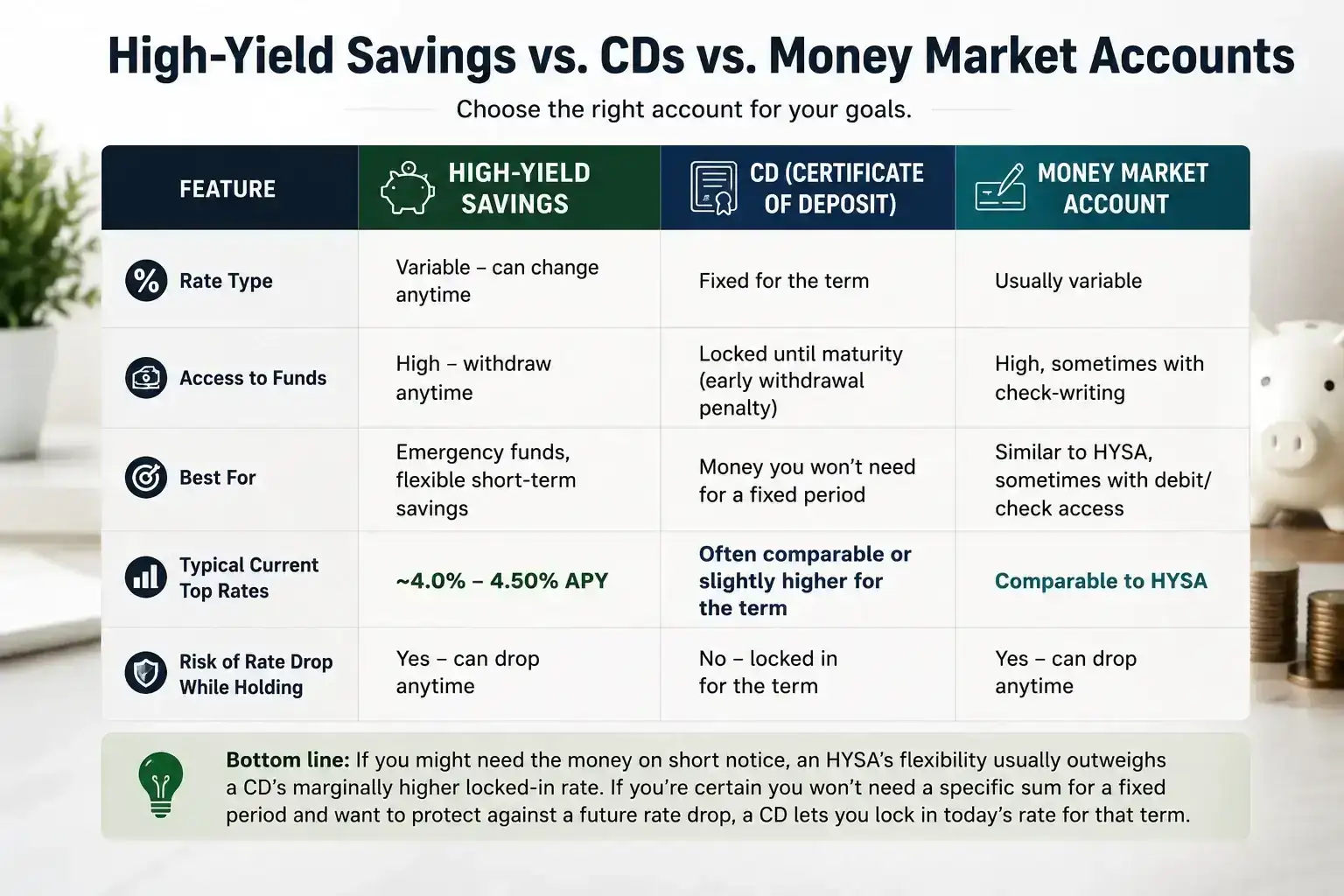
High-Yield Savings vs. CDs vs. Money Market Accounts
Feature | High-Yield Savings | CD (Certificate of Deposit) | Money Market Account |
|---|---|---|---|
Rate type | Variable can change anytime | Fixed for the term | Usually variable |
Access to funds | High withdraw anytime | Locked until maturity (early withdrawal penalty) | High, sometimes with check-writing |
Best for | Emergency funds, flexible short-term savings | Money you won't need for a fixed period | Similar to HYSA, sometimes with debit/check access |
Typical current top rates | ~4.0%–4.5% APY | Often comparable or slightly higher for the term | Comparable to HYSA |
Risk of rate drop while holding | Yes can drop anytime | No locked in for the term | Yes |
Bottom line: if you might need the money on short notice, an HYSA's flexibility usually outweighs a CD's marginally higher locked-in rate. If you're certain you won't need a specific sum for a fixed period and want to protect against a future rate drop, a CD lets you lock in today's rate for that term.
Is Your Money Actually Safe in a High-Yield Savings Account?
Yes, provided the institution is FDIC-insured (or NCUA-insured for credit unions) this is non-negotiable and should be confirmed before opening any account, not assumed. FDIC insurance covers up to $250,000 per depositor, per insured bank, per ownership category. Online-only banks that are FDIC members carry the exact same federal protection as a traditional branch bank; the "online-only" structure affects convenience and overhead costs, not deposit safety.
Pro Tip: If you're holding more than $250,000 in cash savings, spreading it across multiple FDIC-insured institutions (or ownership categories, such as individual vs. joint accounts) keeps the full balance insured rather than leaving a portion exposed.
Who Should and Shouldn't Prioritize a High-Yield Savings Account
Good fit:
Building or holding an emergency fund
Saving for a near-term goal (under ~2–3 years) where you don't want market risk
Parking cash temporarily between other financial decisions
Not the right tool:
Long-term retirement savings a tax-advantaged retirement account and diversified investments generally outperform cash savings over decades, even at today's elevated HYSA rates
Money you're confident you won't touch for years a CD or investment account may fit better depending on your goals
Frequently Asked Questions About Best High
What is a good APY for a savings account right now? As of mid-2026, top high-yield savings accounts are paying roughly 4.0%–4.5% APY, compared to a reported national average of around 0.38%. "Good" generally means meaningfully above that national average with no or low monthly fees check current rates directly, since this figure shifts regularly.
Are high-yield savings accounts safe? Yes, as long as the account is at an FDIC-insured bank or NCUA-insured credit union, which protects deposits up to $250,000 per depositor, per institution, per ownership category. Confirm insurance status directly on the bank's site before opening an account.
Is my money safe at an online-only bank? If the online bank is FDIC-insured, your deposits carry the same federal protection as a traditional branch bank. The lack of physical branches doesn't reduce deposit insurance coverage.
How often do high-yield savings account rates change? Rates are variable and can change at any time, though in practice many banks adjust every few weeks to a few months, generally tracking Federal Reserve policy moves and each bank's own funding needs.
Is a high-yield savings account better than a CD right now? It depends on whether you need flexible access to the money. HYSAs let you withdraw anytime but the rate can drop; CDs lock in today's rate for a fixed term but penalize early withdrawal. With rates currently near multi-year highs, some savers use CDs specifically to lock in today's rate before a possible future decline while others prioritize an HYSA's flexibility.
Key Takeaways: Best High
Top high-yield savings accounts are currently paying roughly ten times the national average rate this gap is unusually wide by historical standards
The headline APY isn't the whole story check minimum balance requirements, fees, and whether the rate is promotional
FDIC or NCUA insurance is non-negotiable; confirm it directly, don't assume it
HYSAs suit short-term, flexible savings goals not long-term retirement investing
Because rates are variable and change often, treat any "current best rate" claim (including the one in this article) as time-stamped, not permanent
Financial Disclaimer & Regulatory Disclosure
This article is for educational and informational purposes only and does not constitute financial or investment advice. FinanceFlows.site is not a registered investment advisor or bank. Annual percentage yields (APYs), account terms, and fees change frequently and vary by institution verify current rates and terms directly with each bank before opening an account. Always confirm FDIC or NCUA insurance status directly with the institution. Consult a licensed financial professional regarding your individual circumstances.
References
Federal Deposit Insurance Corporation (FDIC), national deposit rate data and deposit insurance rules, fdic.gov
Federal Reserve, FOMC rate decisions and target federal funds rate, federalreserve.gov
Bankrate, high-yield savings account rate tracking, bankrate.com
NerdWallet, high-yield savings account comparisons, nerdwallet.com
Fortune / Curinos LLC, daily savings and CD rate reporting, fortune.com
US News & World Report, savings account rate data, usnews.com
National Credit Union Administration (NCUA), share insurance coverage rules, ncua.gov
Note for editorial team: the Rate Alert box, the comparison table's "typical current top rates" row, and every APY figure in this article need to be re-verified against Bankrate/NerdWallet/FDIC data at minimum monthly this is the one article on the site where a stale number does real reputational damage, since it's a direct, checkable claim.
📊 Related Tool: Even a modest 0.35% APY difference compounds into hundreds of dollars over time; calculate your exact cash trajectory with our compound interest calculator. Pairing a high-yield account with our savings goal calculator ensures you stay on track to fund your down payment or major purchase on schedule.
📈 See How Much Your HYSA Earns Over Time
Use our Savings Goal Calculator to model compound growth at any HYSA rate and find exactly how long it takes to reach your target balance with monthly contributions.
Savings Goal Calculator →Frequently Asked Questions: Best high yield savings
What is best high yield savings and why does it matter?
Best high yield savings provides crucial financial direction for investors and households. Understanding best high yield savings helps you make informed allocation choices, reduce unnecessary fees, and optimize your overall returns.
How can you apply best high yield savings in your financial strategy?
To implement best high yield savings successfully, start by assessing your current risk profile and timeline. Consistently monitoring best high yield savings ensures your portfolio stays aligned with long-term goals.
What are common pitfalls to avoid with best high yield savings?
The most common mistake when evaluating best high yield savings is reacting to short-term market noise. Focus on verifiable data, compound growth, and proven principles when making decisions based on best high yield savings.