Quick Answer: Nvidia's $500 Billion AI Financing Deal Explained
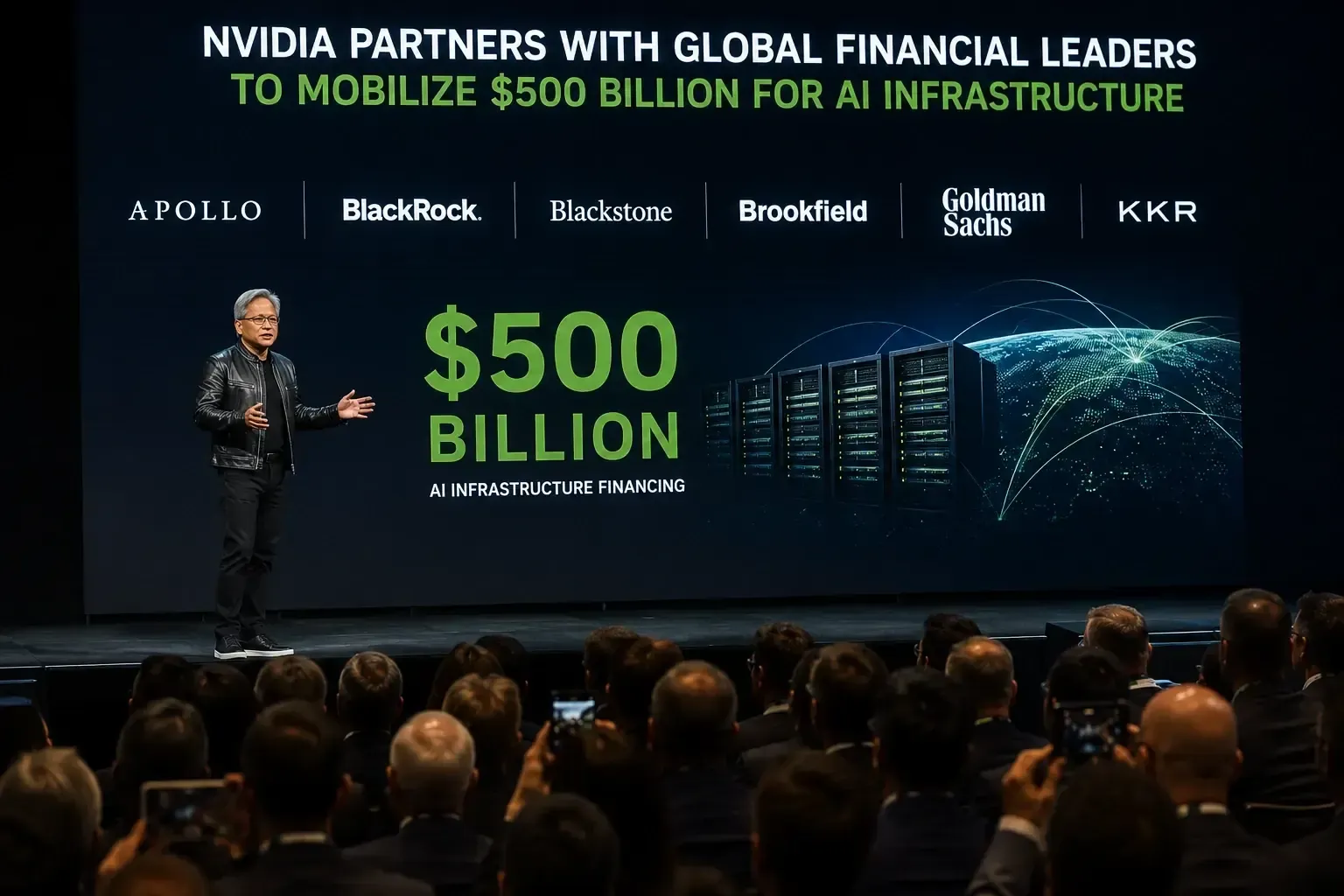
Nvidia announced on August 10, 2026, that it has signed memorandums of understanding with six of the world's largest financial institutions, Apollo Global Management, BlackRock, Blackstone, Brookfield Asset Management, Goldman Sachs, and KKR, to mobilize more than $500 billion in third-party capital for building out AI infrastructure. The plan effectively turns Nvidia's AI chips and compute capacity into a new investable asset class, similar to how investors finance commercial real estate or toll roads, using the value of AI compute itself as collateral. Nvidia isn't acting as a lender in these deals; the six partner firms will independently underwrite and deploy the capital through their own platforms, while Nvidia connects its customer base, including major AI labs, enterprises, and cloud providers, with this new pool of institutional financing. Goldman Sachs CEO David Solomon said the goal is to "create a market for credit backed by NVIDIA compute," and CEO Jensen Huang told CNBC he approached only these six firms, and none turned him down.
Key Takeaways: Nvidia's $500 Billion AI Financing Deal Explained
Nvidia signed memorandums of understanding on August 10, 2026, with Apollo, BlackRock, Blackstone, Brookfield, Goldman Sachs, and KKR to mobilize over $500 billion in AI infrastructure financing
Nvidia is not a lender in these deals; the six partner firms will independently underwrite and deploy capital through their own financing platforms
The structure treats AI compute capacity as collateral, similar to how commercial real estate or infrastructure assets are financed, using private offerings and bonds issued through special-purpose entities
Goldman Sachs is the only traditional bank in the coalition and is positioned to lead public debt deals while distributing investment returns through its asset management arm
CEO Jensen Huang said he approached only six firms for this financing commitment, and none declined
The announcement follows recent reports that Nvidia was in talks to guarantee financing for a roughly quarter-trillion-dollar AI data center for OpenAI, though it's unclear if that deal is part of this broader financing push
The move comes after a rough July for AI-related stocks, when investors began openly questioning whether Big Tech's massive AI spending would ultimately pay off
Some analysts and reporters have flagged renewed concern about "circular financing" in AI, where a major supplier like Nvidia helps arrange financing for the same customers that buy its chips
The coalition represents enormous combined financial firepower: Apollo alone manages roughly $1.05 trillion in assets, Blackstone manages more than $1.3 trillion, and Brookfield oversees more than $1 trillion globally
For comparison, Apollo's own $35 billion financing deal for Broadcom's custom AI chips, announced just days earlier and called the "largest origination" in its sector's history, is roughly 14 times smaller than this new $500 billion target
How Nvidia's $500 Billion Plan Actually Works
This isn't Nvidia writing a $500 billion check, and it's worth being precise about the mechanics, since the structure is genuinely different from a typical corporate financing announcement.
The six partner firms, Apollo, BlackRock, Blackstone, Brookfield, Goldman Sachs, and KKR, will each independently underwrite and deploy capital through their own dedicated financing platforms. Nvidia's role is to connect its customer base, frontier AI labs, enterprises, and cloud computing providers, with this new pool of institutional financing, rather than acting as the lender itself. According to reporting from The National, the financing will use compute power as collateral, structured through private offerings and bonds issued by special-purpose entities capable of raising tens of billions of dollars at a time.
Jensen Huang's framing of the deal, that Nvidia compute is "an investable asset," gets at the core idea. The pitch to these institutional investors is that Nvidia's chips and the AI infrastructure built around them generate long-duration, usage-linked revenue, similar in concept to how an office building or a toll road generates predictable cash flow that can be borrowed against. Goldman Sachs CEO David Solomon put it directly in the companies' joint statement, saying the group's goal is to "create a market for credit backed by NVIDIA compute," and disclosed that Huang was the one who approached the Wall Street group with the idea for the financing project.
The Six Partner Firms and Their Scale
Firm | Approximate Assets Under Management | Role in the Coalition |
|---|---|---|
Apollo Global Management | ~$1.05 trillion (as of June 30, 2026) | Independent underwriting and capital deployment |
BlackRock | World's largest asset manager | Independent underwriting and capital deployment |
Blackstone | $1.3 trillion+ | Independent underwriting and capital deployment |
Brookfield Asset Management | $1 trillion+ | Deep exposure to physical infrastructure and energy financing |
Goldman Sachs | N/A (investment bank) | Only traditional bank in the group; leads public debt deals, distributes returns via its asset management arm |
KKR | Major alternative asset manager | Alternative asset management and capital markets capabilities |
Figures compiled from NVIDIA's official press release, Wall Street Times, and Alternatives Watch coverage dated August 10 to 11, 2026.
Why Nvidia Is Doing This Now
The timing of this announcement is worth connecting to the broader AI investment story we've tracked throughout 2026. As we detailed in our July 2026 stock market recap, the Nasdaq-100 posted its worst month since March 2025 in July, driven partly by investors openly questioning whether the enormous scale of AI infrastructure spending from companies like Alphabet, Amazon, and Meta would actually translate into revenue. CNBC's own reporting on this deal notes it comes directly after that "July swoon in global markets in which investors began asking whether Big Tech's AI investments would pay off."
This financing push can be read, at least in part, as an attempt to broaden who's funding the AI buildout beyond Big Tech's own balance sheets. Rather than relying solely on hyperscalers' cash flow and corporate borrowing, this structure opens the door for institutional and insurance capital, the kind of money Apollo and its peers have historically deployed into infrastructure like toll roads and power plants, to fund AI data centers instead. Alternative asset managers have already been moving in this direction; Apollo and Blackstone, among others, have already structured debt and equity financing for AI companies including Anthropic, and Apollo's own $35 billion financing deal for Broadcom's custom AI chips, announced just days before this larger announcement and described by Apollo CEO Marc Rowan as "the largest origination in our sector ever," is dwarfed by this new $500 billion target, roughly fourteen times larger.
The "Circular Financing" Concern
Not every reaction to this announcement has been positive. As Axios noted in its coverage, the move "could reignite fears about the circular nature of AI financing," a structure where a major chip supplier like Nvidia helps arrange or facilitate financing for the very companies that then use that money to buy Nvidia's own products. This concern isn't new to 2026's AI boom, critics have raised similar questions about vendor financing arrangements throughout the AI infrastructure buildout, but a deal of this scale, and one explicitly designed by Nvidia itself, brings that tension into sharper focus.
It's also worth noting the timing relative to a separate, still-unclear storyline: recent reports had suggested Nvidia was in talks to guarantee financing for a roughly quarter-trillion-dollar AI data center project tied to OpenAI, one of its most important customers. As of this announcement, it remains unclear whether that specific OpenAI-related financing backstop is part of this broader $500 billion coalition or a separate arrangement entirely.
What This Means for Nvidia's Stock and AI Investors
For investors trying to gauge whether this is bullish or cautionary for Nvidia specifically, the honest answer is that it's genuinely both, depending on which piece you focus on. On one hand, this deal signals extraordinary continued institutional confidence in the AI infrastructure buildout, with six of the world's largest asset managers collectively committing to help finance $500 billion worth of it, a scale that would have seemed almost unimaginable just a few years ago. That's consistent with the pattern we've tracked in our breakdown of the 2026 AI stock boom, where memory chipmakers and infrastructure names have repeatedly benefited from the scale of ongoing AI capital expenditure.
On the other hand, this financing push also underscores just how much capital the current AI buildout actually requires, and how much of that capital increasingly needs to come from outside Big Tech's own balance sheets. That's a useful reminder that AI infrastructure spending remains an enormous, capital-intensive undertaking with real financing risk attached, not a guaranteed one-way trade. It's a dynamic worth keeping in mind alongside our coverage of Micron's own dramatic stock swings despite record AI-driven results and SanDisk's similar boom-and-correction cycle, both of which show how quickly sentiment around AI infrastructure names can shift even when underlying demand remains genuinely strong.
For investors who want exposure to the broader AI infrastructure theme, including chipmakers, memory producers, and now this new institutional financing layer, without concentrating risk in any single company's earnings or financing announcements, our beginner's guide to the best ETFs to buy in 2026 covers how to build more diversified exposure to this theme.
Key Takeaways Recap: Nvidia's $500 Billion AI Financing Deal Explained
Nvidia's $500 billion AI financing partnership with six of Wall Street's largest firms marks one of the most ambitious attempts yet to turn AI compute infrastructure into a mainstream, institutionally financeable asset class, using compute capacity itself as collateral rather than relying solely on Big Tech's own balance sheets. The deal reflects genuine, enormous institutional confidence in the continued AI infrastructure buildout, but it also draws attention to how capital-intensive that buildout has become, and it's already reviving familiar concerns about circular financing arrangements within the AI industry. Coming just weeks after a rough July for AI-linked stocks, this announcement is likely to remain a key reference point for how investors weigh the durability of AI infrastructure spending heading into the rest of 2026.
This article is for informational and educational purposes only and does not constitute financial or investment advice. Stock prices are highly volatile and pending financial agreements can change or fail to materialize. Speak with a licensed financial advisor before making investment decisions.
📊 Related Tools: Use our US Inflation & Purchasing Power Calculator to track how geopolitical events, energy spikes, and tariff changes impact real purchasing power. Use our Mortgage Payment & Interest Rate Calculator to see how Federal Reserve rate adjustments and Treasury yields change monthly borrowing costs.
Frequently Asked Questions: Nvidia ai financing
What is nvidia ai financing and why does it matter?
Nvidia ai financing provides crucial financial direction for investors and households. Understanding nvidia ai financing helps you make informed allocation choices, reduce unnecessary fees, and optimize your overall returns.
How can you apply nvidia ai financing in your financial strategy?
To implement nvidia ai financing successfully, start by assessing your current risk profile and timeline. Consistently monitoring nvidia ai financing ensures your portfolio stays aligned with long-term goals.
What are common pitfalls to avoid with nvidia ai financing?
The most common mistake when evaluating nvidia ai financing is reacting to short-term market noise. Focus on verifiable data, compound growth, and proven principles when making decisions based on nvidia ai financing.