If you want investment income without picking individual stocks, dividend ETFs are the most efficient tool most beginners will ever use. One trade gives you dozens or hundreds of dividend-paying companies, professional index screening, and in the best funds cost structures under 0.10% a year.
This guide compares the ETFs that consistently show up at the top of 2026 rankings, explains the real tradeoffs between them, and gives you a framework for choosing one instead of guessing.
Key takeaway: There is no single "best" dividend ETF. There's a best fund for your specific goal current income, dividend growth, or maximum diversification and this guide is built around helping you identify which goal actually applies to you.
What Is a Dividend ETF?
A dividend ETF is a fund that holds a basket of dividend-paying stocks, selected and weighted according to a rules-based index, and passes the dividends through to shareholders usually quarterly, sometimes monthly.
It differs from buying individual dividend stocks in three practical ways:
Diversification a single trade can spread your money across 75–600+ companies
Rules-based screening the index, not a fund manager's opinion, decides what qualifies (years of consecutive increases, payout sustainability, financial quality)
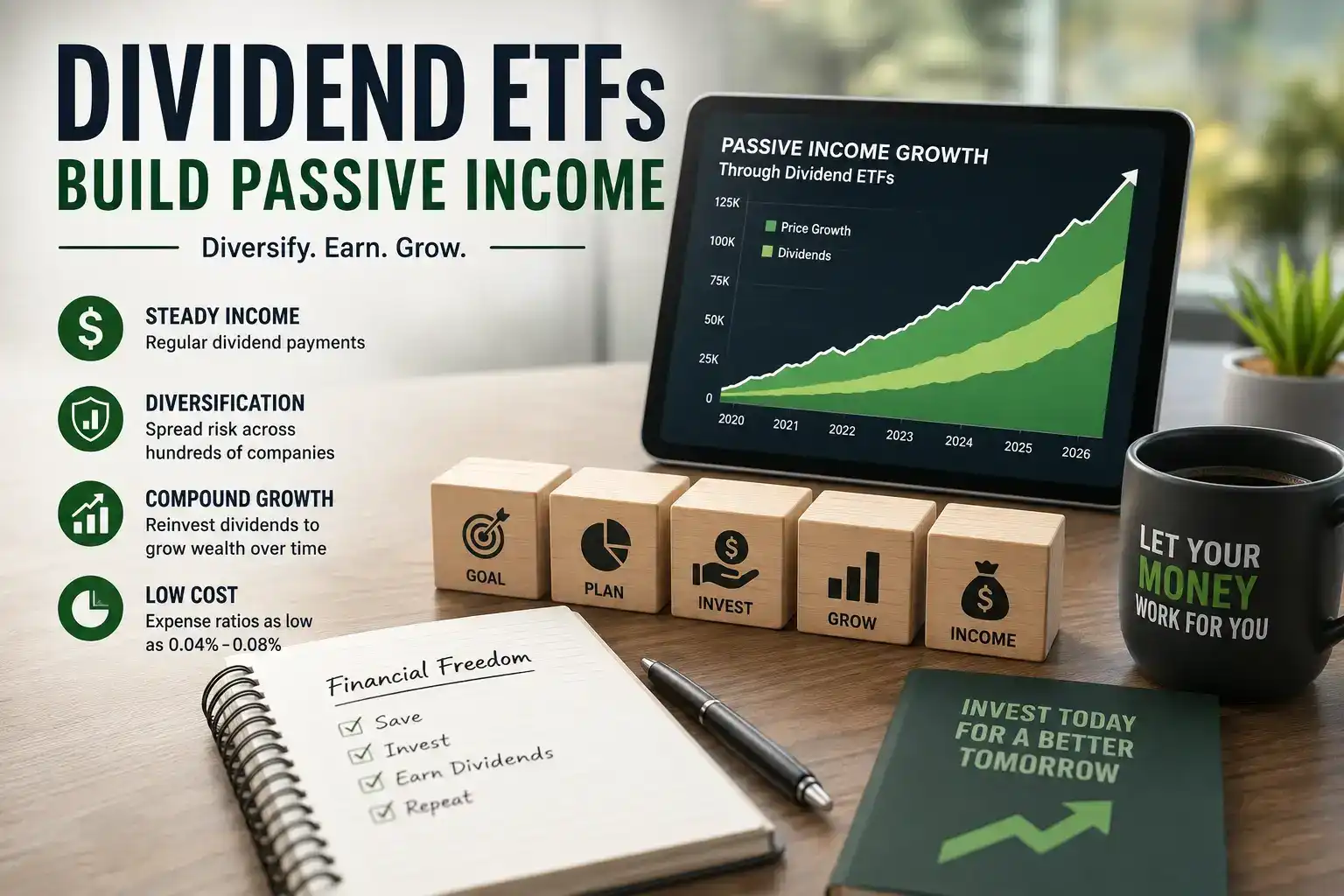
Cost the best funds in this category charge 0.04%–0.08% a year, far below actively managed income funds
Why Rates Matter Right Now
Dividend ETFs don't exist in a vacuum they compete with cash. As of mid-2026, the Federal Reserve has held its benchmark federal funds rate at a target range of 3.50%–3.75% for several consecutive meetings, with officials signaling a "higher for longer" stance amid still-elevated inflation. That matters for two reasons: it keeps a floor under what savings accounts and Treasury bills pay, so a dividend ETF yielding 2–4% is no longer competing against near-zero cash rates the way it did a decade ago; and it keeps valuation pressure on high-yield, rate-sensitive sectors like utilities and REITs, which show up heavily in some of these funds.
Did you know? Dividends from most U.S. stocks held more than 60 days around the ex-dividend date are "qualified" taxed at the lower long-term capital gains rate (0%, 15%, or 20%) instead of your ordinary income rate. This is one of the underrated reasons dividend ETFs are tax-efficient in a taxable brokerage account.
Comparison Table: Top Dividend ETFs in 2026
ETF | Issuer | Approx. Yield | Expense Ratio | Holdings | Best For |
|---|---|---|---|---|---|
SCHD | Schwab | ~3.3%–3.9% | 0.06% | ~100–103 | Quality + income balance |
VYM | Vanguard | ~2.2%–2.7% | 0.04% | ~440–608 | Maximum diversification |
DGRO | iShares | ~2.2% | 0.08% | Broad | Dividend growth over time |
HDV | iShares | Higher-yield, moat-screened | 0.08% | ~75 | Quality-focused concentration |
SDY | State Street | Moderate-high | ~0.35% | S&P Dividend Aristocrats (20+ yrs) | Long dividend-growth track record |
DVY | iShares | ~3.5% TTM | 0.38% | ~100 | Current income, heavy utility tilt |
Figures reflect approximate, publicly reported ranges as of mid-2026 and change regularly always verify current yield and expense ratio directly on the issuer's fund page (Schwab, Vanguard, iShares, State Street) before investing.
SCHD vs. VYM: The Two Funds Beginners Compare Most
This is the single most-searched dividend ETF comparison, and for good reason the two funds represent genuinely different philosophies:
SCHD tracks the Dow Jones U.S. Dividend 100 Index and screens for dividend quality and sustainability across roughly 100 stocks. It has generally carried a higher yield and stronger total return in recent periods, at the cost of holding a more concentrated, sector-tilted portfolio (heavier in energy, financials, and healthcare).
VYM tracks the FTSE High Dividend Yield Index and holds several hundred stocks, prioritizing breadth over selectivity. It typically charges a marginally lower expense ratio and dilutes single-stock or single-cut risk simply by holding so many more names.
Neither fund has consistently "won" over every stretch SCHD has generally outperformed on quality and yield, VYM has held up better in periods driven by mega-cap breadth. If you're choosing one core dividend ETF and can only pick one, the honest answer is that either is a reasonable choice; the deciding factor is usually how much concentration risk you're comfortable with, not which fund is objectively superior.
Pros & Cons
SCHD
✅ Strong historical yield and total return combination
✅ Quality screen filters out unsustainable "yield trap" dividends
❌ More concentrated (~100 holdings) more sector risk
❌ Lower dividend growth rate than pure dividend-growth funds like DGRO
VYM
✅ Broadest diversification on this list
✅ Lowest expense ratio among major dividend ETFs
❌ Includes some lower-quality, higher-payout-ratio names
❌ Lower total return than SCHD in several recent periods
DGRO
✅ Best positioned if you're worried about inflation eroding a fixed income stream
✅ Excludes the highest-yielding (often riskiest) names
❌ Lower current yield than income-focused peers
How to Choose the Right One for You
Ask yourself one question first: are you trying to generate income today, or build a growing income stream over the next 10–20 years?
Near or in retirement, need current cash flow → lean toward SCHD, VYM, or DVY
Decades from retirement, prioritizing growth → lean toward SCHD, VIG, or DGRO
Want maximum stability with the least single-stock risk → VYM's breadth is hard to beat
Comfortable trading yield for capital preservation and quality → HDV's tighter, moat-focused screen fits
A caution on ultra-high-yield funds: Covered-call ETFs and some high-yield funds advertise yields well above 10%. These generate income by selling options against the portfolio, which caps upside and can erode the fund's underlying value (NAV) over time. They serve a specific income-extraction purpose for some investors, but they are not a substitute for or a "better version of" a core dividend growth holding like SCHD or VYM. If you're new to dividend investing, start with a broad, low-cost core fund before considering these.
Building a Simple Dividend ETF Portfolio
A framework, not a recommendation for your specific situation:
Passive, long-horizon investor: one core low-cost fund (e.g., a broad dividend growth or quality fund), reinvest dividends automatically through your broker's DRIP program, review annually
Retiree needing monthly cash flow: a mix that includes at least one monthly-distribution fund alongside a quarterly-paying core holding, so income arrives more evenly through the year
Conservative investor: weight more heavily toward the most diversified, lowest-volatility option and treat any high-yield fund as a small satellite position, not a core holding
This is general education, not a personalized recommendation the right mix depends on your tax situation, account type (taxable vs. IRA/401(k)), time horizon, and risk tolerance. A fee-only fiduciary advisor or a tool like the IRS's own guidance on qualified dividends can help you apply this to your specific numbers.
Frequently Asked Questions About Best Dividend ETFs for Passive Income in 2026
Are dividend ETFs a good investment? For investors who want income plus diversification without picking individual stocks, dividend ETFs are generally considered an efficient, low-cost way to access a basket of dividend-paying companies. Like any equity investment, they carry market risk and can lose value.
Are dividend ETFs better than individual dividend stocks? They trade concentration for diversification. A single stock can cut its dividend or collapse in price; a 100+ stock ETF diffuses that risk, at the cost of never fully matching the return of picking the single best stock in the basket.
What is the safest dividend ETF? "Safest" usually means most diversified and least volatile, not highest-yielding. Broad, low-cost, quality-screened funds are typically considered lower-risk than concentrated, ultra-high-yield funds.
How much money do I need to live off dividend ETF income? This depends entirely on the yield of your holdings and your annual spending need. As a rough illustration only (not a plan): at a blended yield of roughly 3.5%, generating $35,000 a year in dividend income would require roughly a $1 million portfolio before taxes and before accounting for market volatility. Run your own numbers with a retirement calculator rather than relying on a rule of thumb.
Do dividend ETFs pay monthly or quarterly? Most core dividend ETFs (SCHD, VYM, DGRO, HDV) pay quarterly. Some income-focused and covered-call funds pay monthly.
Key Takeaways: Best Dividend ETFs for Passive Income in 2026
There's no universal "best" dividend ETF only the best fit for your income vs. growth goal
SCHD and VYM are the two most-compared core funds: SCHD leans quality/yield, VYM leans maximum diversification
Expense ratio differences of even 0.1%–0.3% compound meaningfully over decades default to funds under 0.15% unless you have a specific reason not to
Treat double-digit "yield" funds (covered-call ETFs) as a separate, higher-risk category, not a core holding
Reinvesting dividends (DRIP) is generally the stronger long-term compounding strategy for investors who don't need current income
Financial Disclaimer & Regulatory Disclosure
This article is for educational and informational purposes only and does not constitute financial, investment, tax, or legal advice. FinanceFlows.site is not a registered investment advisor. ETF yields, expense ratios, holdings, and performance figures change frequently verify current data directly with the fund issuer before making any investment decision. All investing involves risk, including possible loss of principal. Consult a licensed, fee-only financial advisor or tax professional regarding your individual circumstances before investing.
Related Financial Guides & Tools
📊 Related Tool: Before selecting a fund, determine how much capital you need to invest to generate your target passive income stream using our dividend income and DRIP calculator. Beginners often overlook that total equity return combines yield with share price appreciation; model your combined portfolio trajectory on our compound interest calculator.
📊 Project Your Dividend Income
Use our free calculator to model how your dividend portfolio grows with DRIP reinvestment over 10, 20, or 30 years. See exactly when you'll hit your passive income target.
Use the Dividend DRIP Calculator → What Is Dividend Investing? →Frequently Asked Questions: Best dividend etfs 2026
What is best dividend etfs 2026 and why does it matter?
Best dividend etfs 2026 provides crucial financial direction for investors and households. Understanding best dividend etfs 2026 helps you make informed allocation choices, reduce unnecessary fees, and optimize your overall returns.
How can you apply best dividend etfs 2026 in your financial strategy?
To implement best dividend etfs 2026 successfully, start by assessing your current risk profile and timeline. Consistently monitoring best dividend etfs 2026 ensures your portfolio stays aligned with long-term goals.
What are common pitfalls to avoid with best dividend etfs 2026?
The most common mistake when evaluating best dividend etfs 2026 is reacting to short-term market noise. Focus on verifiable data, compound growth, and proven principles when making decisions based on best dividend etfs 2026.