Quick Answer: SpaceX Stock Crash 2026
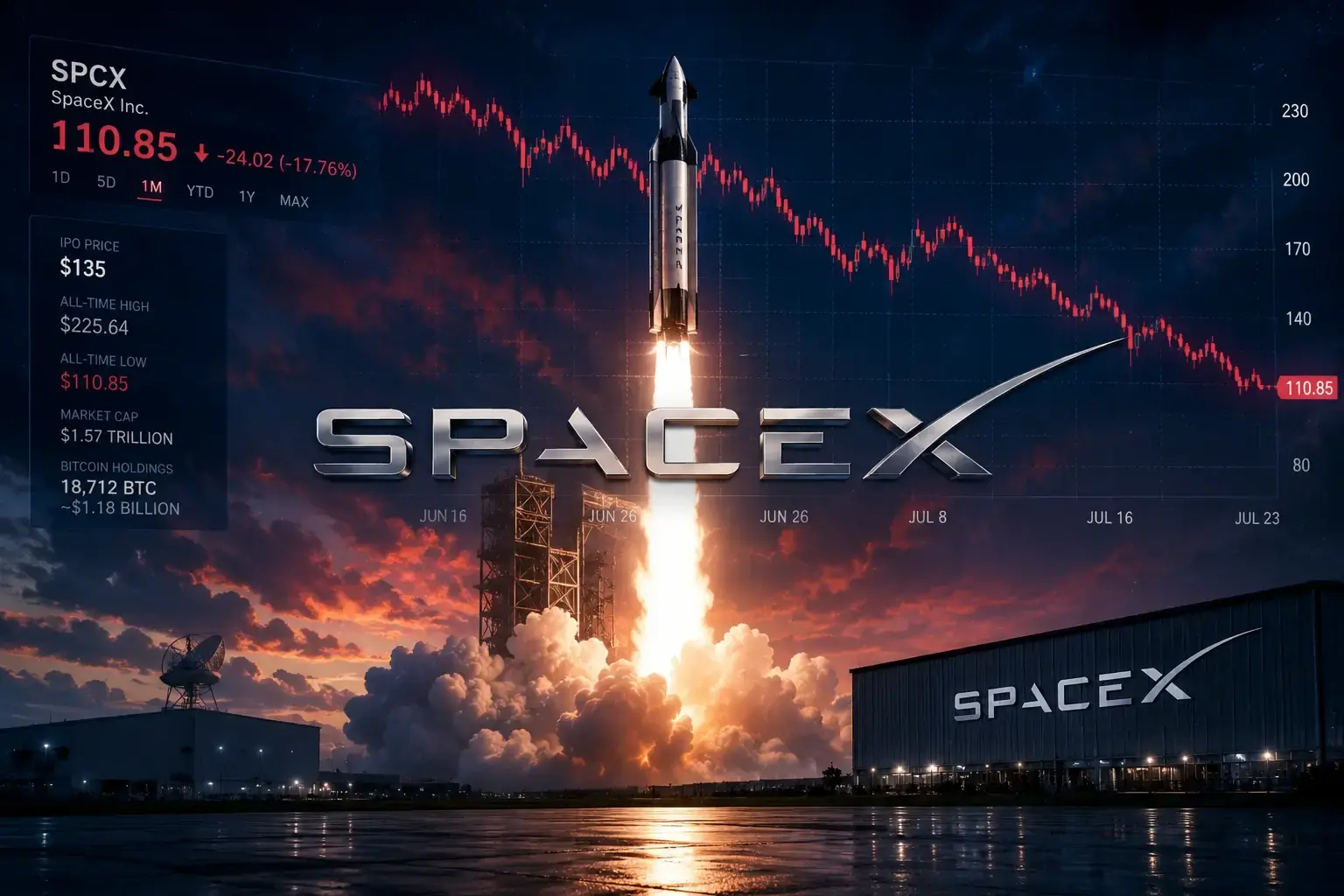
SpaceX completed one of the largest initial public offerings in history on June 12, 2026, pricing shares at $135 and watching them rocket to an all time high of $225.64 just four days later. The rally didn't last. By July 23, 2026, SpaceX stock, trading under the ticker SPCX, hit a fresh all time low of $110.85, putting shares more than 50% below their peak and well under the original IPO price. The decline has wiped out roughly $1 trillion in market value from the stock's post IPO high, dropping the company from a peak valuation near $2.6 trillion to somewhere closer to $1.5 to $1.7 trillion. Adding an unusual wrinkle to the story, SpaceX disclosed that it holds 18,712 Bitcoin on its balance sheet, meaning the stock's crash is now tangled up with the same Bitcoin volatility we've covered in our full Bitcoin price prediction for 2026.
Key Takeaways: SpaceX Stock Crash 2026
SpaceX priced its IPO at $135 a share on June 12, 2026, and debuted trading at $150
Shares hit an all time high of $225.64 on June 16, 2026, just four days after listing
By July 23, 2026, SPCX hit a fresh all time low of $110.85, down more than 50% from its peak in roughly five weeks
SpaceX's market capitalization has fallen from a peak of approximately $2.6 trillion to around $1.57 trillion
The company disclosed holdings of 18,712 Bitcoin as of March 31, 2026, worth roughly $1.18 billion at current Bitcoin prices near $63,000
SpaceX posted a net loss of $4.9 billion in 2025 and lost another $4.28 billion in the first quarter of 2026
A 911.5 million share lockup expiration is still pending, a major overhang that could add further selling pressure
Despite the crash, the average Wall Street analyst price target sits around $242, implying most analysts remain bullish even after the plunge
SpaceX is scheduled to host its first earnings call since going public around August 4, 2026
From Record Breaking IPO to Rapid Reversal
SpaceX's stock market debut was, by almost any measure, historic. The company priced its IPO at $135 a share on June 12, 2026, capping months of anticipation after insider share sales earlier in the year had already pushed its private market valuation as high as $800 billion. Shares opened trading at $150 and kept climbing from there, reaching an all time high of $225.64 just four trading days later, on June 16.
That's when the momentum reversed. The descent since mid June has been steady and largely uninterrupted. Shares crossed below the $135 IPO price for the first time on July 15, a psychologically significant level since it meant anyone who had bought at the offering price was now sitting on a paper loss. The slide continued from there, and by July 23, SPCX touched a fresh all time low of $110.85, putting the stock more than 50% below its June peak in barely five weeks of trading.
The financial toll has been enormous in absolute terms. SpaceX's market capitalization peaked at roughly $2.6 trillion during its post IPO run, and had fallen to approximately $1.57 trillion as of late July, according to TradingView data, a decline of well over $1 trillion in paper value in a little over a month.
SpaceX Stock Timeline at a Glance
Date | Price / Event | Context |
|---|---|---|
Jun 12, 2026 | IPO priced at $135; opens at $150 | One of the largest IPOs in history |
Jun 16, 2026 | All time high of $225.64 | Just four trading days after debut |
Jul 11, 2026 | Falls 4.51% | Part of a multi day slide following Nasdaq 100 inclusion |
Jul 13, 2026 | Falls another 4.24% | Approaches the $135 IPO price |
Jul 15, 2026 | Crosses below $135 IPO price for the first time | Closes around $135.27; intraday low of $132.15 |
Jul 17, 2026 | Trades around $124.35 | Continued pressure ahead of Starship's 13th test flight |
Jul 23, 2026 | Fresh all time low of $110.85 | More than 50% below the June peak |
Figures compiled from CNBC, Yahoo Finance, Quartz, The Motley Fool, and TradingView data as of late July 2026. SPCX is highly volatile; always check a live source for the current price.
The Surprising Bitcoin Connection
One of the stranger threads in this story is SpaceX's balance sheet. The company disclosed holdings of 18,712 Bitcoin as of March 31, 2026, valued at approximately $1.29 billion at the time. With Bitcoin now trading near $63,000, a level we broke down in detail in our Bitcoin price prediction for 2026, that position is worth roughly $1.18 billion today.
That makes SpaceX one of the more significant corporate Bitcoin holders in the world, in the same conversation as companies like Strategy and Tesla. It also creates something unusual: a newly listed stock that, from its very first day of trading, has functioned partly as a leveraged proxy for Bitcoin's price. Right now, that's not working in SpaceX shareholders' favor. Both Bitcoin and SPCX have been under pressure simultaneously in 2026, and when a company's own equity is already sliding, having a meaningful chunk of its balance sheet tied to another volatile, declining asset compounds the pressure rather than offsetting it.
Why Investors Have Turned Cautious
A few distinct factors are weighing on the stock beyond the general "post IPO cooling off" pattern that many high profile debuts eventually experience.
The financials are genuinely rough. SpaceX posted a net loss of $4.9 billion in 2025, and followed that with an additional $4.28 billion loss in the first quarter of 2026 alone. For a company valued in the hundreds of billions to trillions of dollars, losses of that magnitude keep the pressure on valuation, particularly once initial IPO enthusiasm fades and investors start focusing more on fundamentals.
Starship's execution risk remains real. SpaceX's ambitious plans, including orbital data centers and eventual moon and Mars missions, depend heavily on the Starship rocket program succeeding at a reliable, high frequency launch cadence. The most recent test flight before this one lost its Super Heavy booster after heat damage during separation, and the program's 13th test flight, the second flight of the larger Starship Version 3 design, was scheduled just as the stock hit its most recent low, adding a layer of binary, headline driven risk to an already jittery stock.
A massive lockup expiration still looms. A 911.5 million share lockup remains pending, meaning a huge additional supply of shares could hit the market once early investors and insiders are permitted to sell. Markets often price in anticipation of lockup expirations well before they actually occur, which can weigh on a stock independent of any single day's news.
Competitors are moving too. Rival Blue Origin, backed by Amazon founder Jeff Bezos, is reportedly raising new capital at a $130 billion valuation, its first public fundraise. A well funded competitor gaining ground doesn't help sentiment around SpaceX at a moment when its own stock is already under pressure.
Is Wall Street Still Bullish on SpaceX?
Despite the sharp decline, most analyst coverage on SpaceX has remained relatively optimistic. The average Wall Street price target sits around $242, which would imply significant upside from current levels near $110 to $135. That optimism is built around SpaceX's unusual combination of businesses: rocket launches, Starlink satellite broadband, satellite to phone service, and ambitions in both terrestrial and eventual orbital data centers tied to AI infrastructure demand, a theme closely related to the broader AI stock boom we've been tracking throughout 2026.
Not every voice on Wall Street shares that optimism, however. Some skeptics argue the stock remains overvalued even after its steep pullback, pointing to the company's persistent losses and the unresolved technical challenges around Starship's orbital data center ambitions. The debate is likely to intensify around SpaceX's first earnings call since going public, expected around August 4, 2026, which will give investors their first real look at quarterly financials as a public company.
What SpaceX Stock Crash 2026 Means for Investors
SpaceX's post IPO plunge is a useful, real time reminder of how differently a stock can behave once it moves from private, headline driven valuation markups to the daily scrutiny of public trading. A company can have a genuinely exciting long term story, cutting edge rocket technology, a dominant satellite broadband business, and ambitious AI adjacent plans, and still see its stock fall sharply if the price at IPO already priced in years of future success.
For investors drawn to high profile, high volatility names like SpaceX, this stretch also illustrates why concentrated positions in a single newly public stock carry meaningfully more risk than a diversified approach. If you're looking to participate in space, satellite, or AI infrastructure themes without betting everything on one volatile name, our beginner's guide to the best ETFs to buy in 2026 covers how broader, diversified exposure can help manage that kind of single stock risk, particularly with SpaceX's large pending share lockup still ahead and its next earnings report still to come.
Frequently Asked Questions About SpaceX Stock Crash 2026
Why has SpaceX stock fallen so much since its IPO? SpaceX priced its IPO at $135 in June 2026, rallied to an all time high of $225.64 within days, then fell steadily as post IPO enthusiasm faded, weighed down by continued heavy losses ($4.9 billion in 2025 and $4.28 billion in Q1 2026), Starship execution risk, and an upcoming 911.5 million share lockup expiration.
What is SpaceX's stock ticker? SpaceX trades under the ticker SPCX.
Is SpaceX stock below its IPO price? Yes. Shares first crossed below the $135 IPO price on July 15, 2026, and fell further to a fresh all time low of $110.85 by July 23, 2026.
Why does SpaceX hold Bitcoin? SpaceX disclosed holdings of 18,712 Bitcoin on its balance sheet as of March 31, 2026. This makes the stock behave partly like a leveraged Bitcoin proxy, since movements in Bitcoin's price directly affect the value of a meaningful portion of SpaceX's balance sheet.
Is SpaceX stock a buy after the crash? Views are mixed. The average Wall Street analyst price target of around $242 suggests many analysts remain bullish, but some skeptics point to persistent losses and unresolved technical risk around SpaceX's Starship program and orbital data center ambitions. SpaceX's first earnings call as a public company, expected around August 4, 2026, is likely to be a major catalyst either way.
When does SpaceX report its first earnings as a public company? SpaceX is scheduled to host its first earnings call since its IPO around August 4, 2026.
Key Takeaways Recap: SpaceX Stock Crash 2026
SpaceX's stock market debut went from historic to humbling in a matter of weeks. Shares soared more than 65% above their $135 IPO price within four days of listing, then reversed just as sharply, falling to a fresh all time low of $110.85 by July 23, more than 50% below the June peak. Heavy ongoing losses, real execution risk around the Starship program, an enormous pending share lockup, and an unusual $1 billion plus Bitcoin holding have all combined to keep pressure on the stock, even as most Wall Street analysts remain officially bullish. SpaceX's first earnings report as a public company, expected in early August, is shaping up to be the next major test of whether the stock can find a floor.
This article is for informational and educational purposes only and does not constitute financial or investment advice. Stock prices are highly volatile and can change significantly within a single trading day, and newly public companies can be especially unpredictable. Speak with a licensed financial advisor before making investment decisions.
Sources:
Yahoo Finance — SpaceX stock hits all time low, dips below IPO price
Quartz — SpaceX stock sinks below its IPO price for the first time
CNBC — SpaceX stock sinks for a second straight day, nearing $135 IPO price
The Motley Fool — SpaceX Stock Is Now Well Below Its IPO Price
TradingView — SpaceX (SPCX) Stock Price, Chart and IPO Details
📊 Related Tools: Use our ROI & Annualized Return Calculator to measure your historical investment returns and annual compound growth rate across volatile market cycles. Use our Portfolio Visualizer & Asset Allocation Tool to backtest diversified multi-asset portfolios and run Monte Carlo risk simulations.
Frequently Asked Questions: Spacex stock crash
What is spacex stock crash and why does it matter?
Spacex stock crash provides crucial financial direction for investors and households. Understanding spacex stock crash helps you make informed allocation choices, reduce unnecessary fees, and optimize your overall returns.
How can you apply spacex stock crash in your financial strategy?
To implement spacex stock crash successfully, start by assessing your current risk profile and timeline. Consistently monitoring spacex stock crash ensures your portfolio stays aligned with long-term goals.
What are common pitfalls to avoid with spacex stock crash?
The most common mistake when evaluating spacex stock crash is reacting to short-term market noise. Focus on verifiable data, compound growth, and proven principles when making decisions based on spacex stock crash.