Quick Answer: Tesla's $25 Billion Bet
Tesla shares have fallen as much as 18% over the past week, one of the stock's roughest stretches in years, despite the company reporting record second quarter revenue of $28.2 billion. The disconnect comes down to cash flow. Tesla's free cash flow turned negative for the first time in more than two years, driven by a full year 2026 capital expenditure plan that's ballooned to more than $25 billion, nearly triple the $8.53 billion Tesla spent in 2025. Investors, already digesting a broader wave of AI spending anxiety across the market, this same week, we detailed how Alphabet's own higher spending forecast rattled markets, are questioning whether Tesla's bet on AI infrastructure, robotaxis, and humanoid robots will pay off quickly enough to justify the cash burn.
Key Takeaways: Tesla's $25 Billion Bet
Tesla reported record Q2 2026 revenue of $28.2 billion, up 26% year over year and about 10.5% above Wall Street estimates
Adjusted earnings per share came in at $0.33, missing the $0.50 analyst estimate
Free cash flow turned negative for the first time in more than two years, with the company burning through roughly $1.1 billion in cash during the quarter
Operating income fell 57% year over year
Full year 2026 capital expenditure guidance now sits above $25 billion, up from an already elevated forecast of over $20 billion just one quarter earlier, and nearly triple 2025's $8.53 billion
Roughly two-thirds of the quarter's reported profit has been attributed to gains on an external equity holding, not core vehicle or energy operations, raising questions about earnings quality
Tesla's trailing price to earnings ratio sits around 330, leaving little room for error if the AI and robotics bet takes longer than expected to pay off
Robotaxi service logged 2.5 million paid passenger miles, with 380,000 of those without an in-car safety monitor, well behind Waymo's more than 220 million autonomous miles
A Record Quarter That the Market Still Punished
On the surface, Tesla's second quarter 2026 results looked strong. Revenue hit an all time high of $28.2 billion, a 26% jump from a year earlier and roughly 10.5% ahead of what Wall Street had modeled. Several of Tesla's newer, higher margin businesses also posted real growth: subscriptions for its Full Self Driving Supervised software climbed 56% to 1.48 million, energy storage deployments rose 41% to 13.5 gigawatt hours, and services and other revenue grew 50%.
None of that was enough to offset what investors saw underneath the headline numbers. Adjusted earnings per share came in at $0.33, well short of the $0.50 analysts had expected. Operating income fell 57% year over year. And for the first time in more than two years, Tesla's free cash flow turned negative, with the company burning through approximately $1.1 billion in cash during the quarter alone, according to InsiderFinance's analysis of the results. That's a swing of roughly $9 billion compared to the positive free cash flow Tesla generated in the same quarter a year earlier.
By 11:30 a.m. ET on July 23, the day after the earnings release, Tesla shares were down more than 13% intraday, making it the worst performer in the S&P 500 that day, and part of the reason the broader market had its worst session in over a month, alongside a sharp Alphabet decline the same week. The stock's decline has continued in the days since, with some tracking services showing Tesla down as much as 18% cumulatively over the past week as of July 26.
Tesla's Q2 2026 Earnings Scorecard
Metric | Q2 2026 Result | Versus Expectations / Prior Year |
|---|---|---|
Revenue | $28.2 billion | Up 26% year over year; beat estimates by ~10.5% |
Adjusted EPS | $0.33 | Missed $0.50 estimate |
Free cash flow | Approximately negative $1.1 billion | First negative quarter in over 2 years; down roughly $9 billion from Q2 2025's positive $5.6 billion |
Operating income | Down 57% year over year | Reflects rising costs tied to the capex ramp |
FSD Supervised subscriptions | 1.48 million | Up 56% |
Energy storage deployments | 13.5 gigawatt hours | Up 41% |
Services and other revenue | Up 50% | Growing higher margin, recurring revenue stream |
Full year 2026 capex guidance | More than $25 billion | Up from over $20 billion guided just one quarter earlier |
Figures compiled from InsiderFinance, TechTimes, Yahoo Finance, and Trefis coverage of Tesla's Q2 2026 earnings release, dated July 22 to 26, 2026.
Why the Capex Number Is the Real Story
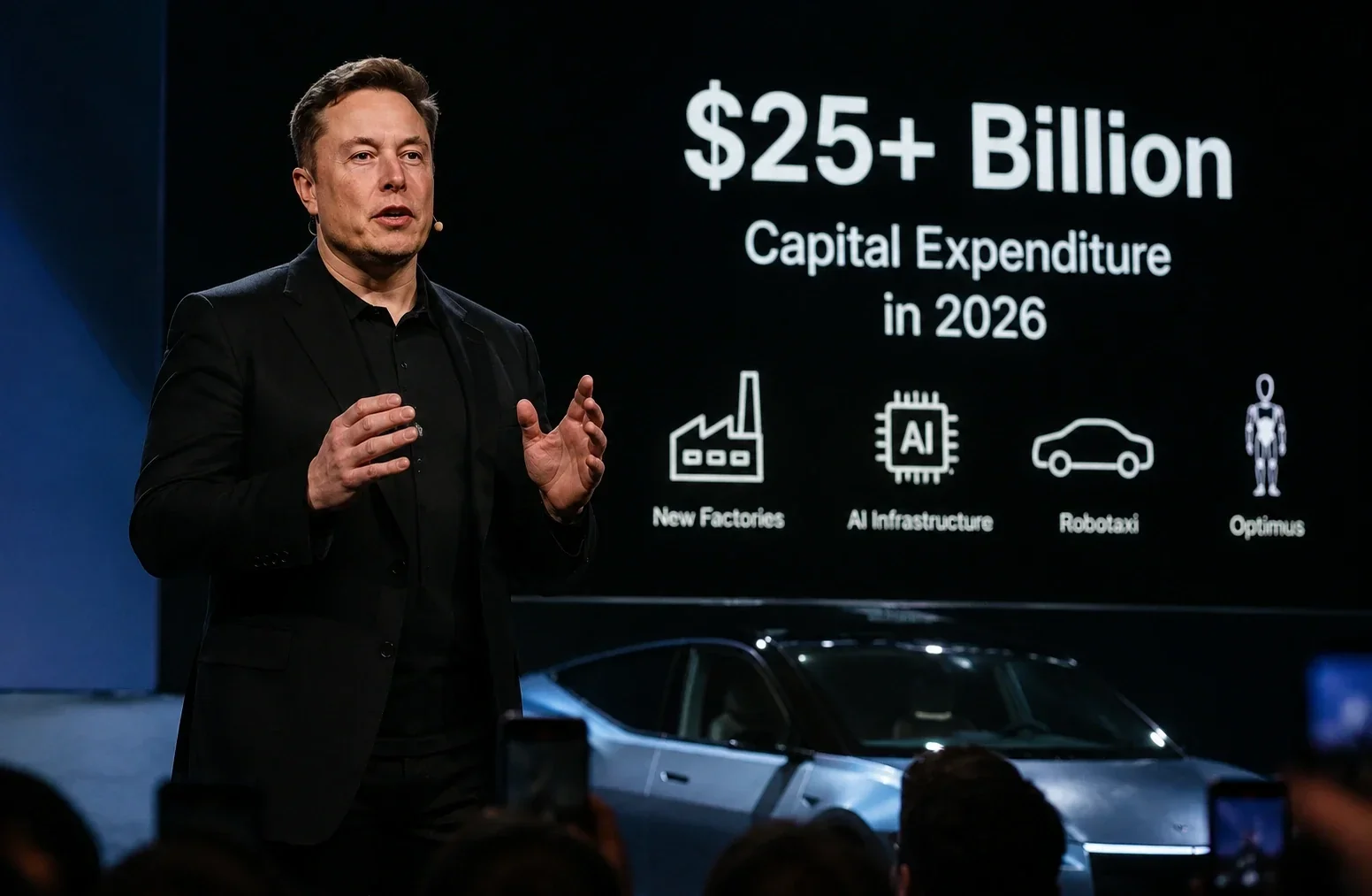
To understand why Wall Street reacted so negatively to what was, in revenue terms, a record breaking quarter, it helps to see how quickly Tesla's spending plans have escalated. The company's 2025 capital expenditures came in at roughly $8.53 billion. For 2026, that figure was initially guided above $20 billion on Tesla's Q1 earnings call, then raised again to more than $25 billion by the time of the Q2 report, according to Yahoo Finance's coverage of the shift. That's nearly three times what Tesla spent just one year earlier, and a step change CEO Elon Musk himself has described 2026 as "a massive capex year."
The money is earmarked for six new factories, expanded AI training infrastructure, and continued development of Tesla's Robotaxi and Optimus humanoid robot programs, the same AI infrastructure buildout theme we've been tracking across the market in our breakdown of the 2026 AI stock boom. Management has been direct that this level of spending will result in negative free cash flow for the remainder of 2026, meaning Tesla expects to burn through more cash than its operations generate for the next several quarters.
That's a difficult message for a stock already carrying a rich valuation. With a trailing price to earnings ratio around 330, Tesla's share price already assumes a great deal of future growth and close to flawless execution. Ryan Lee, senior vice president at Direxion, summed up the market's concern simply: "Monetization remains the central concern following the earnings miss."
A Quality of Earnings Problem, Too
Beyond the cash flow headline, analysts have flagged a second, subtler concern: how much of Tesla's reported profit actually came from its core business. According to InsiderFinance's analysis, roughly two thirds of the quarter's reported profit is tied to gains on an external equity holding, meaning a stock market investment Tesla holds, rather than earnings from selling cars, energy storage, or software. That distinction matters, because it means the underlying profitability of Tesla's actual operating businesses was weaker than the headline profit figure alone suggests, adding another layer of caution to an already jittery market reaction.
The Bull Case: Is the Spending Worth It?
Tesla's spending isn't happening in a vacuum, and the company has posted real progress in some of the areas this capex is meant to support. Robotaxi service has now logged 2.5 million paid passenger miles, including 380,000 miles completed without an in-car safety monitor, an important operational milestone even though it remains well behind Alphabet's Waymo, which has surpassed 220 million autonomous miles as of March. FSD Supervised subscriptions, energy storage deployments, and services revenue all grew at rates that, in isolation, would typically be viewed as strong quarterly results.
The bull case for Tesla rests on the idea that this spending cycle, funding six new factories, AI infrastructure, Robotaxi, and Optimus, positions the company for a much larger revenue base later in the decade, even if it means several quarters of negative free cash flow in the meantime. Management has been candid that initial production of newer products like the Cybercab and Semi will ramp slowly, and that the company is executing across an unusually large number of difficult projects simultaneously.
The Bear Case: Limited Room for Error
The counterargument is straightforward. Tesla's current valuation already prices in substantial future success, and the returns on this $25 billion plus investment are both uncertain and years away, based on management's own guidance. If the payoff from Robotaxi and Optimus is delayed, or smaller than currently hoped, a stock trading at 330 times trailing earnings has very little cushion to absorb that disappointment. Until Tesla shows more tangible, near term progress in autonomy and robotics, particularly disclosed production figures for Optimus, which the company has not yet provided, the elevated spending is likely to keep raising more questions than it answers for skeptical investors.
What Tesla's $25 Billion Bet Means for Your Portfolio
Tesla's this week reaction is a vivid, real time example of a theme playing out across the broader market in 2026: investors are rewarding AI related spending when it's clearly tied to near term, verifiable revenue, and punishing it when the payoff feels distant or uncertain, even alongside genuinely strong top line results. We saw the same dynamic play out with Alphabet the same week, where a cloud earnings beat was overshadowed by a bigger spending increase, and it's a useful lens for thinking about any high growth, high valuation stock right now.
For investors who'd rather not bet heavily on how any single company's AI or robotics roadmap plays out, a diversified approach remains the more risk managed way to stay invested through this kind of earnings driven volatility. Our beginner's guide to the best ETFs to buy in 2026 covers how to build that kind of broader exposure, and our SCHD versus VYM dividend ETF comparison is worth a look if you'd prefer steadier income focused holdings over concentrated, high volatility growth bets like this one.
Key Takeaways Recap: Tesla's $25 Billion Bet
Tesla's second quarter 2026 results captured a genuine tension at the heart of the stock's current story: record revenue and real progress in newer, higher margin businesses, set against a historic ramp in capital spending that's pushed free cash flow negative for the first time in over two years. With capex guidance now above $25 billion, nearly three times what the company spent in 2025, and roughly two thirds of reported profit tied to an external equity gain rather than core operations, investors have grown increasingly focused on whether Tesla's AI, Robotaxi, and Optimus bets will pay off quickly enough to justify a stock still trading at a rich valuation. The next several quarters of cash flow and production updates are likely to be the deciding factor.
This article is for informational and educational purposes only and does not constitute financial or investment advice. Stock prices are highly volatile and can change significantly within a single trading day. Speak with a licensed financial advisor before making investment decisions.
📊 Related Tools: Use our US Inflation & Purchasing Power Calculator to track how geopolitical events, energy spikes, and tariff changes impact real purchasing power. Use our ROI & Annualized Return Calculator to measure your historical investment returns and annual compound growth rate across volatile market cycles.
Frequently Asked Questions: Tesla stock crash 2026
What is tesla stock crash 2026 and why does it matter?
Tesla stock crash 2026 provides crucial financial direction for investors and households. Understanding tesla stock crash 2026 helps you make informed allocation choices, reduce unnecessary fees, and optimize your overall returns.
How can you apply tesla stock crash 2026 in your financial strategy?
To implement tesla stock crash 2026 successfully, start by assessing your current risk profile and timeline. Consistently monitoring tesla stock crash 2026 ensures your portfolio stays aligned with long-term goals.
What are common pitfalls to avoid with tesla stock crash 2026?
The most common mistake when evaluating tesla stock crash 2026 is reacting to short-term market noise. Focus on verifiable data, compound growth, and proven principles when making decisions based on tesla stock crash 2026.