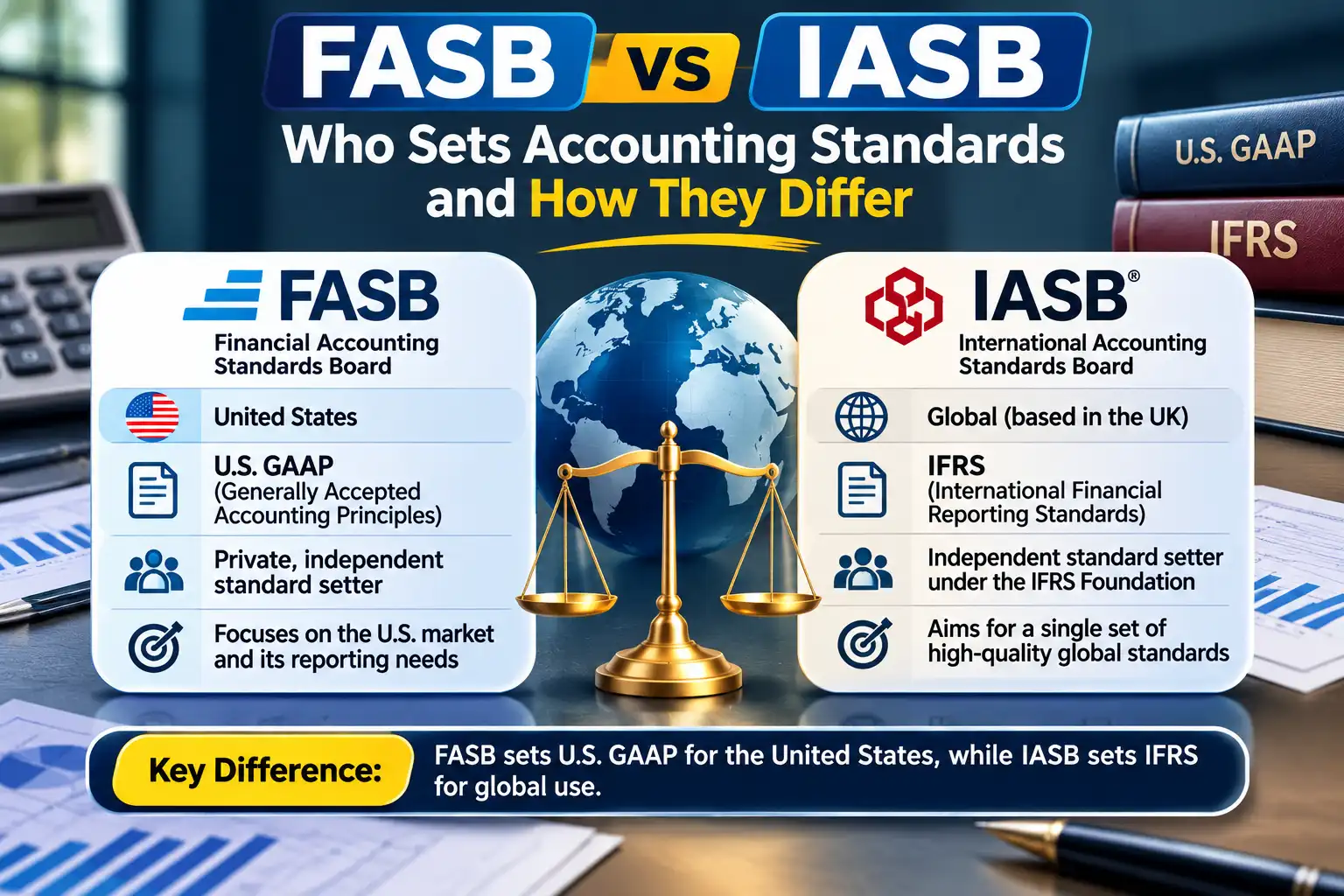
When you see references to GAAP and IFRS, two organizations are ultimately responsible for the rules: the Financial Accounting Standards Board (FASB) and the International Accounting Standards Board (IASB). Understanding who sets accounting standards - and how FASB and IASB differ - is fundamental to interpreting financial statements from US and international companies.
What Is the FASB?
The Financial Accounting Standards Board (FASB) is a private, not-for-profit organization established in 1973. It is the designated standard-setter for US Generally Accepted Accounting Principles (US GAAP) under authority recognized by the Securities and Exchange Commission (SEC).
Key facts about FASB:
- Headquarters: Norwalk, Connecticut, USA
- Founded: 1973 (replaced the Accounting Principles Board, APB)
- Publishes: Accounting Standards Codification (ASC) - the single authoritative source of US GAAP
- Authority: SEC recognizes FASB standards as authoritative for US public companies
- Oversight: Financial Accounting Foundation (FAF)
- Jurisdiction: United States
What Is the IASB?
The International Accounting Standards Board (IASB) is an independent, privately funded body established in 2001, replacing the International Accounting Standards Committee (IASC). It issues International Financial Reporting Standards (IFRS), used in over 140 countries.
Key facts about IASB:
- Headquarters: London, United Kingdom
- Founded: 2001 (replaced IASC which was founded 1973)
- Publishes: IFRS Standards (and legacy IAS standards)
- Oversight: IFRS Foundation
- Jurisdiction: 140+ countries have adopted or permitted IFRS
FASB vs IASB: Key Differences
| Feature | FASB | IASB |
|---|---|---|
| Standards issued | US GAAP (Accounting Standards Codification) | IFRS (and legacy IAS) |
| Geographic scope | United States only | 140+ countries |
| Approach | Rules-based (more detailed prescriptive rules) | Principles-based (broader principles with judgment) |
| US adoption | Mandatory for US public companies | Not permitted for US domestic SEC filers |
| LIFO inventory | Permits LIFO | Prohibits LIFO (IAS 2) |
| Development costs | Generally expensed (ASC 730) | Capitalized when criteria met (IAS 38) |
| Revaluation of assets | Not permitted (cost model only) | Permitted (revaluation model) |
Rules-Based vs Principles-Based Accounting
One of the most fundamental philosophical differences between FASB and IASB is their approach to standard-setting:
FASB (Rules-Based): US GAAP tends toward detailed, specific rules. The Accounting Standards Codification contains thousands of pages of guidance addressing specific industries, transaction types, and edge cases. This provides more certainty but can lead to "bright-line" rules that sophisticated companies structure transactions to avoid.
IASB (Principles-Based): IFRS sets out broader principles and relies on management judgment to apply them to specific circumstances. This reduces the volume of rules but requires more disclosure and professional judgment - and can produce more variation in practice.
The Role of AICPA in US Accounting
A common question is: does the AICPA set GAAP? The answer is - historically yes, but not anymore for public companies.
The American Institute of Certified Public Accountants (AICPA) was the primary US standard-setter before FASB. The AICPA's Accounting Principles Board (APB) set accounting standards from 1959-1973. When FASB was created in 1973, the AICPA formally recognized FASB as the authoritative standard-setter for US GAAP.
Today, AICPA:
- Sets standards for private companies (non-public entities) through the Private Company Council working with FASB
- Issues Statements on Auditing Standards (SAS) for auditors
- Governs the CPA certification and professional conduct
- Does NOT set GAAP for public companies - FASB does
So when comparing "GAAP AICPA vs ISA differences" - ISA stands for International Standards on Auditing (issued by IAASB), which are auditing standards, not accounting standards. GAAP is about measurement and presentation; ISAs are about how audits are conducted.
FASB-IASB Convergence Project
From 2002 to approximately 2012, FASB and IASB worked on a joint convergence project (the "Norwalk Agreement") to eliminate key differences between US GAAP and IFRS. Major achievements included converged standards on:
- Revenue recognition (ASC 606 / IFRS 15)
- Lease accounting (ASC 842 / IFRS 16)
- Business combinations (ASC 805 / IFRS 3)
- Financial instruments (partially - ASC 825 / IFRS 9)
However, full convergence was never achieved, and the active convergence project effectively ended by 2012. FASB and IASB continue to coordinate but operate independently, with no current timeline for US adoption of IFRS.
Will the US Ever Adopt IFRS?
The SEC has the authority to require US public companies to report under IFRS but has never done so. A 2012 SEC staff report concluded that full IFRS adoption was not recommended at that time. As of 2026, US domestic public companies must report under US GAAP - IFRS is only permitted for foreign private issuers filing with the SEC.
Some academics and large multinationals continue to advocate for US IFRS adoption, citing benefits for cross-border comparability and reduced compliance costs for global companies. But US adoption remains politically complex and economically disruptive for companies with long-established GAAP processes.
Key Takeaways
- FASB sets US GAAP; IASB sets IFRS - they are independent organizations
- FASB is rules-based; IASB is principles-based
- AICPA historically set accounting standards but FASB has been authoritative since 1973
- ISA (International Standards on Auditing) is different from IFRS - ISA governs auditing, not accounting measurement
- FASB and IASB converged on revenue, leases, and business combinations but significant differences remain
- The US does not use IFRS for domestic public company reporting as of 2026
What is the difference between FASB and IASB?
FASB (Financial Accounting Standards Board) sets US GAAP for US companies, based in Connecticut. IASB (International Accounting Standards Board) sets IFRS used in 140+ countries, based in London. FASB is rules-based; IASB is principles-based. The US does not currently require IFRS for domestic public companies.
Does the AICPA set GAAP?
No longer for public companies. The AICPA set US GAAP through its Accounting Principles Board (APB) until 1973. When FASB was established, the AICPA transferred that authority. Today, AICPA sets standards for private company reporting and auditing standards (SAS), but FASB sets GAAP for public companies.
What is the difference between GAAP and ISA?
GAAP (Generally Accepted Accounting Principles) governs how financial information is measured, recognized, and presented. ISA (International Standards on Auditing) governs how independent auditors examine and report on financial statements. GAAP is set by FASB (US) or IASB (internationally); ISA is set by IAASB. They serve different purposes.
Is IFRS used in the US?
IFRS is not required for US domestic public companies, which must use US GAAP. However, foreign private issuers filing with the SEC may use IFRS. The SEC has authority to mandate IFRS but has not done so. No current timeline exists for US IFRS adoption as of 2026.